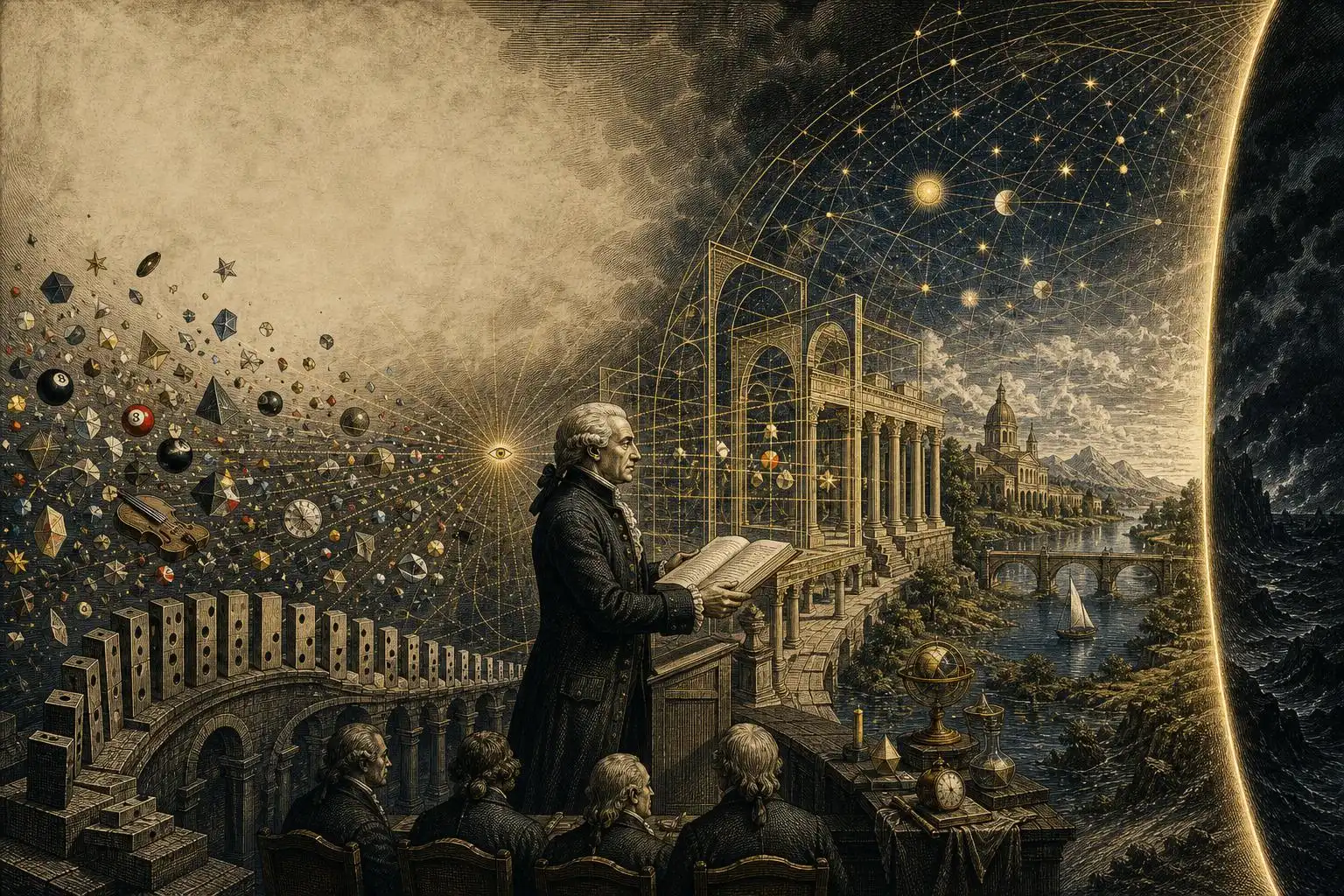

Kant himself called it the deduction that cost him more effort than any other part of the Critique of Pure Reason, and readers have been repaying that debt of effort ever since. The Transcendental Deduction of the Categories sits at the center of the first Critique, in the middle of the Transcendental Analytic, and it is where the entire critical project either succeeds or collapses. If the argument works, Kant has shown that the pure concepts of the understanding — substance, causality, unity, and the rest — are not merely useful habits of thought but conditions without which experience of objects would be impossible at all. If it fails, the Critique is an elaborate description of how minds happen to work, with no claim on necessity.
It is worth being precise about what a “deduction” is here, because Kant is not using the word the way a lawyer or a logician would. He borrows it from eighteenth-century German legal practice, where a Deduktion was a brief establishing a rightful claim to a disputed possession — not proving that something exists, but proving that one has a right to it. The categories are not in dispute as concepts; we already use them. What is in dispute is their legitimacy: by what right does the understanding apply concepts like causality to objects it has never directly perceived causing anything? Hume had already shown that no amount of staring at billiard balls yields the concept of necessary connection. Kant’s deduction is his answer to that challenge, and it is a quaestio juris, a question of right, not a question of fact.
The Problem the Categories Create
The difficulty is sharpened by Kant’s own architecture. He has already argued, in the Transcendental Aesthetic, that space and time are pure forms of intuition — not properties of things in themselves but the subjective conditions under which anything can be given to us as an object of sense at all. That much, he thinks, is secured relatively easily, because space and time just are the forms in which sensibility receives its material; their applicability to appearances is guaranteed by the fact that appearances are appearances in space and time.
The categories present a much less comfortable case. They originate not in sensibility but in the understanding, a wholly different cognitive faculty, one that thinks rather than intuits. There is no obvious reason why concepts native to thought should have any grip on what is given through sense. Kant states the worry starkly: appearances could easily be so chaotic that nothing in them answered to the unity the categories demand. Objects might simply “swarm” before the mind, as he puts it, without the concept of cause or substance finding anything to attach to. The categories, unlike space and time, are not obviously built into the material they are supposed to govern.
This is why Kant insists the deduction of the categories must do something the aesthetic did not need to do: it must show, not merely that we possess these concepts, but that they necessarily apply to any object of possible experience whatsoever. A merely subjective story about how human minds happen to process information would leave open the Humean possibility that the concepts are habits without authority. Kant wants necessity, not habit.
Apperception as the Hinge
The argument turns, famously and notoriously, on what Kant calls the transcendental unity of apperception — the “I think” that must be able to accompany all my representations. This is not empirical self-consciousness, not the psychological fact that I notice myself having thoughts. It is a formal condition: for a manifold of representations to belong to one consciousness at all, they must be combinable into a single self-ascribing “I think.” A representation that could not in principle be accompanied by this “I think” would, Kant says, be nothing to me — it would not count as a representation of mine at all.
From this bare requirement Kant tries to extract an enormous amount of work. Representations are given to sensibility as a manifold, scattered and separate; but for them to constitute my experience, they must be combined, synthesized, into a unity. Combination, Kant insists, is never given by objects themselves — it is always an act of the understanding. And the unity that combination aims at is precisely the unity of apperception. So: whatever concepts are necessary for combining a manifold of sensible intuition into the unity required for it to be my experience are ipso facto necessary conditions of experience as such. The categories, Kant argues, just are these concepts — they are the rules by which the understanding unifies any manifold of sensible intuition into the single consciousness that experience requires.
This is the skeleton of the argument in both the A edition of 1781 and the more compressed, restructured B edition of 1787, though the two versions differ enough in strategy that scholars still argue about whether they are the same proof dressed differently or two distinct attempts. The B edition famously proceeds in two steps: the first establishes that the categories govern any manifold unified in a given sensible intuition as such, without yet specifying whose intuition it is; the second connects this result to the manifold given specifically through human, spatiotemporal intuition, since the first step alone leaves open how such intuition in particular comes to be unified.
Why It Does Not Simply Beg the Question
The obvious objection is that Kant has smuggled the conclusion into the premise. If “experience” is defined from the outset as a unified, judgment-involving cognition of objects, then of course whatever concepts are needed for judgment will turn out to be needed for experience — but this looks like stipulation, not proof. Hume, after all, would simply deny that experience needs to be unified in the strong sense Kant assumes; a Humean bundle of impressions, loosely associated, might be all that “experience” ever amounts to.
Kant’s reply, worked out most carefully in the B edition, is to insist that even the recognition of a mere sequence of impressions as a sequence — as mine, occurring one after another — already presupposes the very synthetic unity he is trying to establish. Even Hume’s bundle, to be a bundle for someone, must be gathered into one consciousness, and gathering is exactly the achievement that requires concepts. The Humean cannot retreat to bare unconceptualized sensation and still call it experience, because bare unconceptualized sensation is not yet anything for a subject at all. Whether this reply succeeds is precisely the question that has occupied the enormous secondary literature on the deduction — from Hermann Cohen’s neo-Kantian reconstruction to P. F. Strawson’s attempt to salvage an “argument from experience” while discarding the transcendental psychology, to Dieter Henrich’s painstaking reconstruction of the argument’s two-step structure.
The Cost of the Proof
What should be resisted is any reading that makes the deduction easy. Kant is not offering a description of mental mechanics that any attentive introspection would confirm; he is offering a proof that the very possibility of a subject having objects before it at all depends on rules the subject itself supplies and could not have derived from those objects. This has consequences he does not shrink from: the categories have legitimate application only to appearances, only within possible experience, and any attempt to extend them to things in themselves — to use causality or substance to reach beyond what can be given in intuition — oversteps the warrant the deduction actually establishes.
That restriction is the deduction’s other face. It is simultaneously a proof of the categories’ objective validity and a fence around that validity, and Kant is explicit that the same argument which secures the categories for appearances forbids their use for speculative metaphysics about God, the soul, or the world as a whole. Reading the deduction only for its positive conclusion and ignoring this negative boundary is to miss half of what Kant thought he had shown. The chapter that follows the deduction, the Schematism, exists precisely because a pure concept and a sensible manifold are so heterogeneous that some further mediating procedure is needed even after the deduction has done its work — a reminder that establishing a right of application is not yet the same as showing how, in each case, that right gets exercised.



Leave a Reply