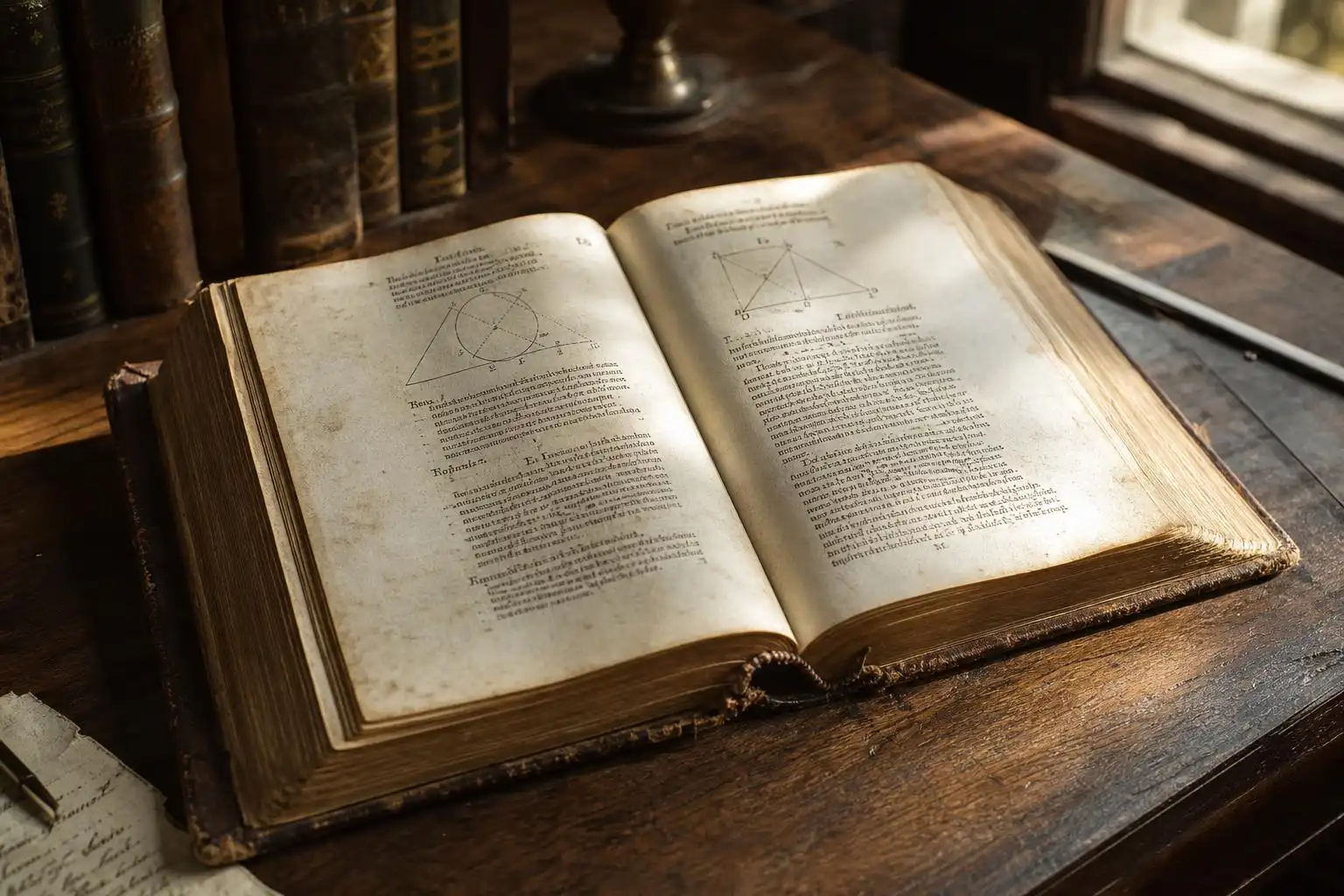

Open the Ethics and within the first few pages Spinoza has committed himself to a claim that still stops readers cold: there is exactly one substance, and everything else — every mind, every body, every thought and stone and star — is a mode of it. Not a part, not a creation standing apart from its maker, but a mode, in the way a wave is a mode of the sea. This is substance monism, and it is not a mystical flourish tacked onto an otherwise sober metaphysics. It is the conclusion of an argument that unfolds with the patience of a geometric proof, because Spinoza wrote it as one.
To see why he lands there, you have to start where he starts: with definitions most readers skate past too quickly. A substance, Spinoza says, is “that which is in itself and is conceived through itself, that is, that whose concept does not require the concept of another thing from which it must be formed.” This is Descartes’s language, lightly modified, but Spinoza will not let it stay decorative. He means it with a rigor that Descartes never quite matched, and the whole system falls out of taking the definition seriously.

The Definition Does the Work
Descartes had used “substance” loosely enough to allow created substances — minds and bodies — that depend on God for their existence but are nonetheless conceived independently of anything else, in the sense that thinking doesn’t require extension and extension doesn’t require thinking. Spinoza spots the instability here immediately. If a substance’s concept must not require the concept of another thing, and if minds and bodies as Descartes describes them still depend on God for their very being, then in what sense are they “conceived through themselves”? Their existence is borrowed. Spinoza concludes that only something whose existence is not borrowed from anything else deserves the name substance at all.
This sets up the first hard result in the Ethics: two substances cannot share an attribute. An attribute, for Spinoza, is what the intellect perceives as constituting the essence of a substance — thought and extension are the two we have access to. If two substances shared an attribute, they could not be distinguished by that attribute. Nor could their modes distinguish them, because substance is prior in nature to its modes and must be considered apart from them. Since a substance is by definition self-conceived, no two substances can share an attribute. Difference in attribute is the only way substances can differ at all.
From here the argument to monism is almost mechanical, though its consequences are anything but. Spinoza defines God as a substance consisting of infinite attributes, each expressing infinite essence — in other words, absolute infinity, from whose essence no attribute expressing essence can be denied. He then argues that God necessarily exists. If another substance existed, it would have to share some attribute with God; but no two substances can share an attribute. God, therefore, is the only substance there is.
Why Minds and Bodies Don’t Count as Separate Things
This is where Descartes’s dualism gets swallowed whole. Thought and extension, for Descartes, were the defining attributes of two distinct kinds of created substance: minds and bodies, really separate yet genuinely interacting, with the pineal gland assigned a central role. Spinoza keeps thought and extension as genuine, irreducible attributes — he is not a materialist who reduces mind to matter, nor an idealist who reduces matter to mind. But he relocates them. They are not attributes of two different substances. They are two attributes of the single substance, God or Nature, perceived by us as fundamentally different ways of expressing one and the same reality.
This is the notorious slogan “Deus sive Natura,” God or Nature, and it is worth being precise about what it does and doesn’t say. It does not say God is identical to the physical universe in the sense of being reducible to matter — extension is only one of infinite attributes, and human minds only grasp two of them, thought and extension, out of an infinity we cannot conceive. It says that whatever we call God and whatever we call Nature turn out, on analysis, to be the same substance under different descriptions. There is no super-being standing outside or above the natural order, issuing commands to it from elsewhere. The order is itself the deity, considered as active cause rather than passive effect.
Individual things — you, your body, this sentence forming in your mind — are modes, finite and determinate expressions of the one substance’s infinite attributes. A mode “is in another thing, through which also it is conceived,” which is the mirror image of the substance definition. Your existence and your concept both depend on something else. You are, by analogy, like a particular figure that can be drawn within an infinite plane: real, determinate, but not free-standing. The plane does not depend on the figure; the figure depends entirely on the plane.
The Argument’s Real Pressure Point
Where does this leave freedom? Spinoza’s answer is as unflinching as the rest of the system: nothing is free in the sense of being uncaused. God himself acts from the necessity of his own nature, not from choice among alternatives, because there is no “outside” from which alternatives could be selected — there is nothing but the one substance, unfolding according to its own essence with the same necessity by which it follows from the nature of a triangle that its angles equal two right angles. Human freedom, on this picture, is not freedom from causation but a kind of self-determination — acting from adequate understanding of one’s own nature rather than being pushed and pulled by passions whose causes remain opaque to us.
Critics since the seventeenth century have pressed hardest on one point: does the argument actually rule out multiple substances, or does it just define “substance” so narrowly that the word can no longer apply to ordinary things like people and rocks, leaving the interesting metaphysical question of how many independent things there are untouched? Leibniz, reading Spinoza with real alarm, thought the system was almost right and disastrously wrong at once — right that a genuine substance must have an internal principle of action, wrong to conclude that only one substance could exist, and he built the monadology partly as an alternative that preserves plurality through created monads that depend on God, each mirroring the rest without literally sharing attributes.
That disagreement — whether Spinoza’s conception of self-sufficiency entails uniqueness, or whether plurality can be preserved among created substances causally independent of one another — is really the disagreement between rationalist metaphysics of the following century, and it starts exactly where Spinoza’s definitions leave off. It is worth sitting with the proof itself, though, before rushing to the objections, because Spinoza’s argument has a peculiar virtue rare among grand metaphysical systems: at every step, you can see exactly which definition is doing the work, and exactly where you would have to disagree if you wanted to escape the conclusion. Most readers find they cannot disagree with any single step. They simply arrive, a little disoriented, at a universe with room in it for only one thing.



Leave a Reply