
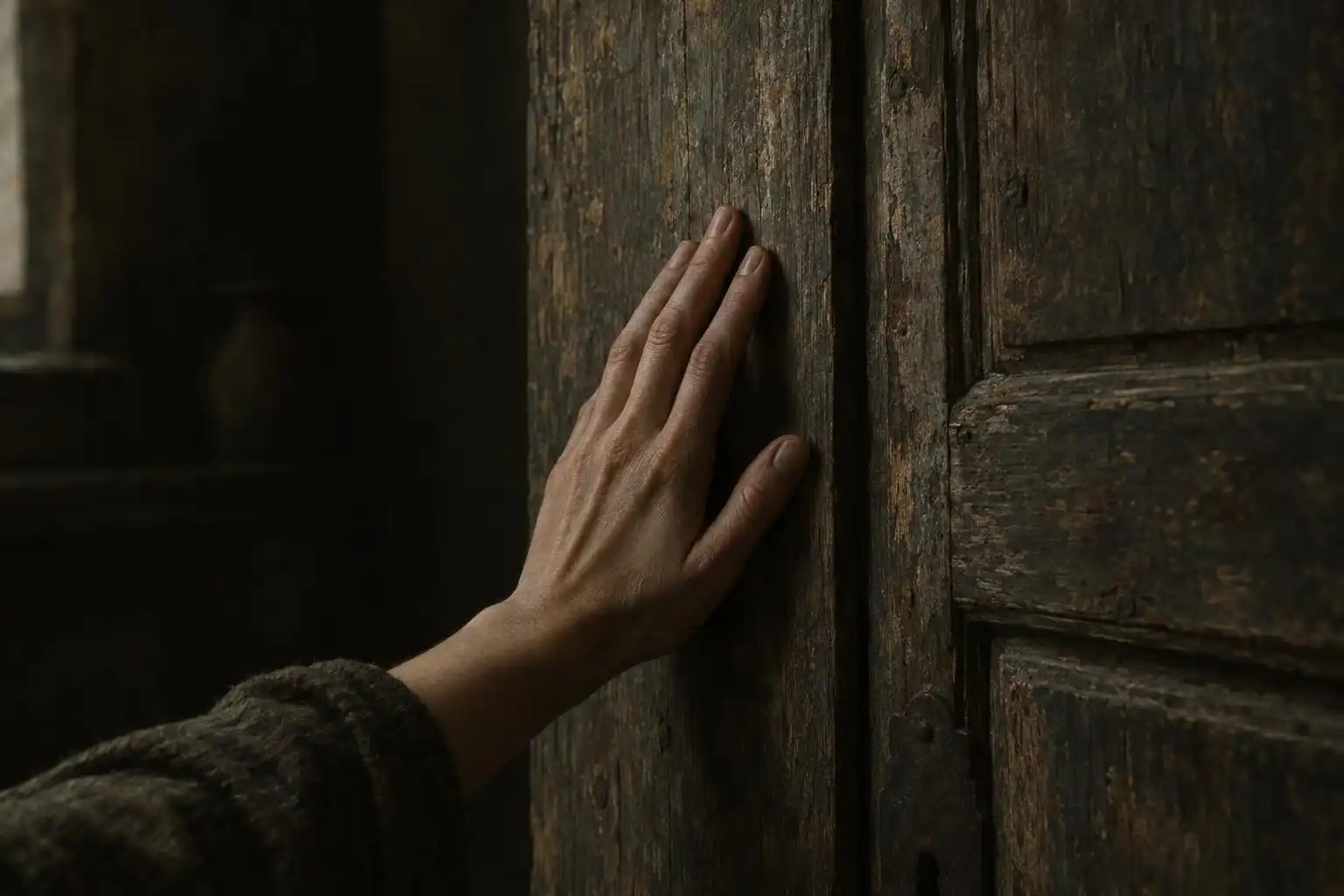

Suppose you press your hand against a locked door. You feel resistance: something stops you. Yet you can encounter that resistance only because you were trying to move. For Johann Gottlieb Fichte, this ordinary situation contains a philosophical problem. How can consciousness experience a world that limits it without treating that world as wholly alien to the activity of consciousness?
Fichte’s answer in the 1794–95 Foundations of the Entire Wissenschaftslehre begins with the I and the not-I. Those terms sound forbiddingly abstract. They are meant to account for something precise: the difference between acting, meeting a limit, and recognizing the limit as one you did not simply choose.

The I Is Not Your Personality
Fichte’s first principle says that the I posits itself. This is easily mistaken for a claim that an individual mind creates everything. But the I here is not Johann Fichte, or you, imagining a universe into existence. It names the activity involved in being conscious at all. To say “I” is not merely to point to an object already lying there. The act of thinking includes an awareness of itself as thinking.
Fichte takes up a problem Kant had left exposed. Kant argued that experience requires the “I think” to be able to accompany my representations. But what kind of unity does that requirement involve? Fichte refuses to treat self-consciousness as a passive container into which experiences arrive. The I is an activity: it must be understood through what it does, not as a hidden thing behind its acts.
This does not mean that self-consciousness is effortless self-knowledge. I do not inspect an inner object and discover an I with a list of properties. Fichte’s opening principle concerns the condition for making such judgments in the first place. If it is read as a psychological observation about an unusually powerful ego, the argument has already gone wrong.
Why the Not-I Appears
The second principle opposes a not-I to the I. Opposition matters because a consciousness containing no distinction could determine nothing. There would be no difference between its activity and what that activity encounters. To know anything definite, the I must face something opposed to it.
Here the difficulty becomes sharp. If the I posits itself without qualification, how can something opposed to it stand? And if the not-I simply comes from outside as an independent thing, has Fichte not abandoned his attempt to explain experience through the conditions of consciousness? His third principle addresses the conflict: a divisible I and a divisible not-I limit one another. Neither simply abolishes the other. Their opposition becomes determinate.
“Divisible” is not a claim that a person or a stone can be cut into philosophical pieces. It means that limitation admits of degrees and boundaries. At the locked door, my effort continues, but my movement stops here. The obstacle does not erase my activity; my activity does not erase the obstacle. Experience takes shape through that relation.
The Check on Activity
Fichte gives this encounter with limitation a name: Anstoß, often translated as “check” or “impulse.” An activity meets resistance, and its course is altered. Without a check, the I could not become conscious of itself as finite, directed toward something it does not simply control.
The check must not be confused with a complete theory of the object that checks us. Fichte is not pointing behind experience to a Kantian thing in itself and announcing that it strikes the mind. Nor is he saying that the finite individual freely invents the resistance it feels. The argument requires a check on activity; it does not let us step outside consciousness to describe an independently operating cause of that check.
This is the hardest point in the account, and it should remain hard. Fichte wants to explain why an objective world is necessary for finite consciousness without claiming to see reality from nowhere. Critics can reasonably ask whether the Anstoß smuggles in the very independence his system seems unable to derive. Calling it a “check” gives the problem a place in the argument; it does not make the problem disappear.
Freedom Is Not the Absence of Resistance
If the not-I limits the I, why connect this account to freedom? Because Fichte’s freedom is not the power to make obstacles vanish. An action needs a determinate situation: something to work on, a boundary to cross, a failure that calls for another attempt. An I without resistance would have no task and no occasion to exercise its powers.
This changes how the locked door should be understood. It is not merely evidence that my will is weak. I can test the handle, seek a key, or decide that entering would be wrong. Each response presupposes a world I must reckon with. None follows automatically from the bare fact that the door is locked. The limit makes practical deliberation possible without dictating its outcome.
Fichte’s account of striving gives this structure a wider scope. The finite I seeks to bring what confronts it into accord with its aims, yet a final state in which every opposition has vanished would also remove the field of its activity. Striving is therefore not an inconvenient interval before freedom finally begins. It is the form freedom takes for a finite agent.
What the System Cannot Simply Settle
There is a temptation to make Fichte’s argument reassuring: the world resists us, resistance gives us purpose, and all is well. That conclusion comes too quickly. A check may be necessary for finite consciousness, but the necessity of limitation does not tell us why this particular limit appears, how it ought to be met, or whether every resistance deserves to be overcome.
The Foundations presses a more exacting question. If I can understand myself as active only where my activity is checked, then self-consciousness depends on what it cannot simply command. Fichte does not begin with a solitary ego surveying objects it has manufactured. He begins with activity and discovers that its finitude must be accounted for.
Return to the hand against the door. You know the resistance through the effort it interrupts; you know your effort as bounded by what resists it. Fichte’s question is whether that reciprocal structure can explain the experience of an independent world without claiming an impossible view from outside experience. The hand remains against the door, and the question remains open.


Leave a Reply
You must be logged in to post a comment.