
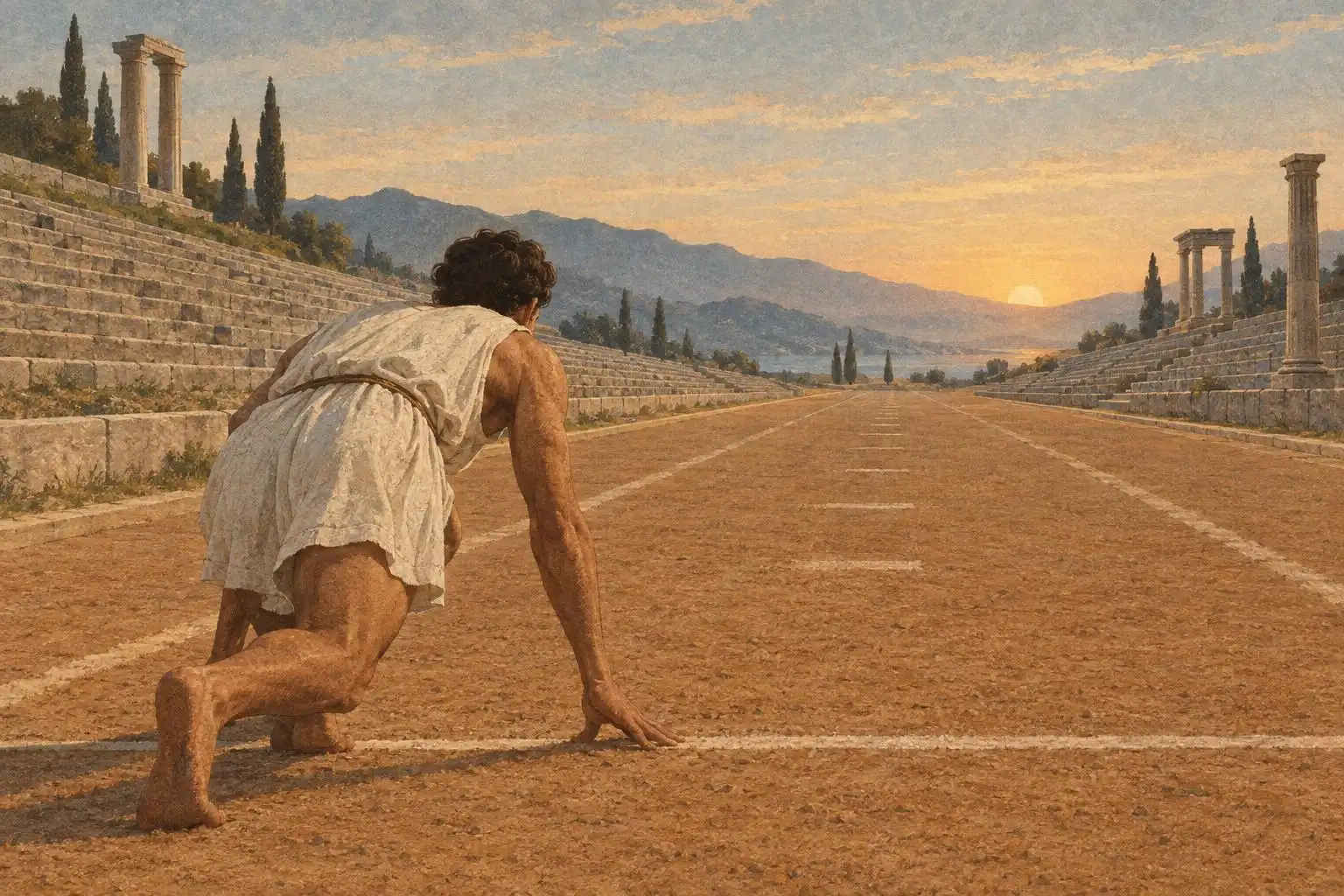

A runner sets off across a track. Before reaching the far end, she must reach the halfway point. Before that, she must reach the halfway point of the first half. There is always another point she must reach first. The track is ordinary; the difficulty lies in the word before. Zeno of Elea made that small word bear an astonishing weight.
A Book Written Against the Many
Zeno wrote in the fifth century BCE, in the intellectual company of Parmenides, who had argued that what is cannot come to be, pass away, or change. We possess none of Zeno’s book intact. Plato’s Parmenides presents it as a defense of Parmenides: Zeno takes the assumptions of people who say there are many things and tries to show that those assumptions produce still stranger consequences. Plato gives us a dramatic account of the book, not a transcript of it.
That matters because the familiar motion paradoxes are only part of what antiquity attributed to Zeno. Some of our closest approaches to his own wording concern plurality. They survive in quotations by Simplicius, writing roughly a thousand years later. Between Zeno’s argument and our page stand lost manuscripts, ancient interpreters, and the questions those interpreters wanted to ask.
How Many Things Are There?
One surviving argument begins with a deceptively firm demand. If there are many things, they must be exactly as many as they are: neither more nor fewer. In that respect, Zeno says, they are limited. Yet between any two things there will be another, and between those another again. In that respect, they are unlimited. The many seem to be both limited and unlimited.
The step about what lies between is where a reader should hesitate. Why must another thing stand between two things? If the things are discrete units, perhaps nothing does. If they are portions of something continuous, however, each supposed unit can be divided again. Zeno presses on a difficulty his opponents cannot settle merely by pointing to a crowd, a row of stones, or the visible parts of a body: what counts as one thing in the first place?
Another fragment makes the pressure sharper. Something without magnitude, Zeno argues, would add nothing to a thing if attached to it and subtract nothing if removed. But if a thing has magnitude, it has extent; and its extended parts invite further division. The surviving lines push toward an uncomfortable choice between parts too small to contribute anything and an indefinitely proliferating structure of parts. Precisely how every step of the latter argument worked remains disputed. The fragment gives us the pressure, not an intact proof with every premise exposed.
The Race Against Halves
Aristotle preserves the best-known motion arguments in his Physics. In the dichotomy, a body moving toward a destination must first cover half the distance; to cover that half, it must first cover half of it. Taken backward toward the starting line, the required stages have no first member. How does the runner begin a journey if a prior crossing is required before every crossing?
Taken forward, the same division poses a related question: how can she finish if there are infinitely many halfway points to pass? The two versions need not trouble us in exactly the same way. At the start, Zeno seems to deny a first completed task. At the finish, he asks whether infinitely many tasks can be completed at all. Calling them both “the halfway paradox” can conceal the difference.
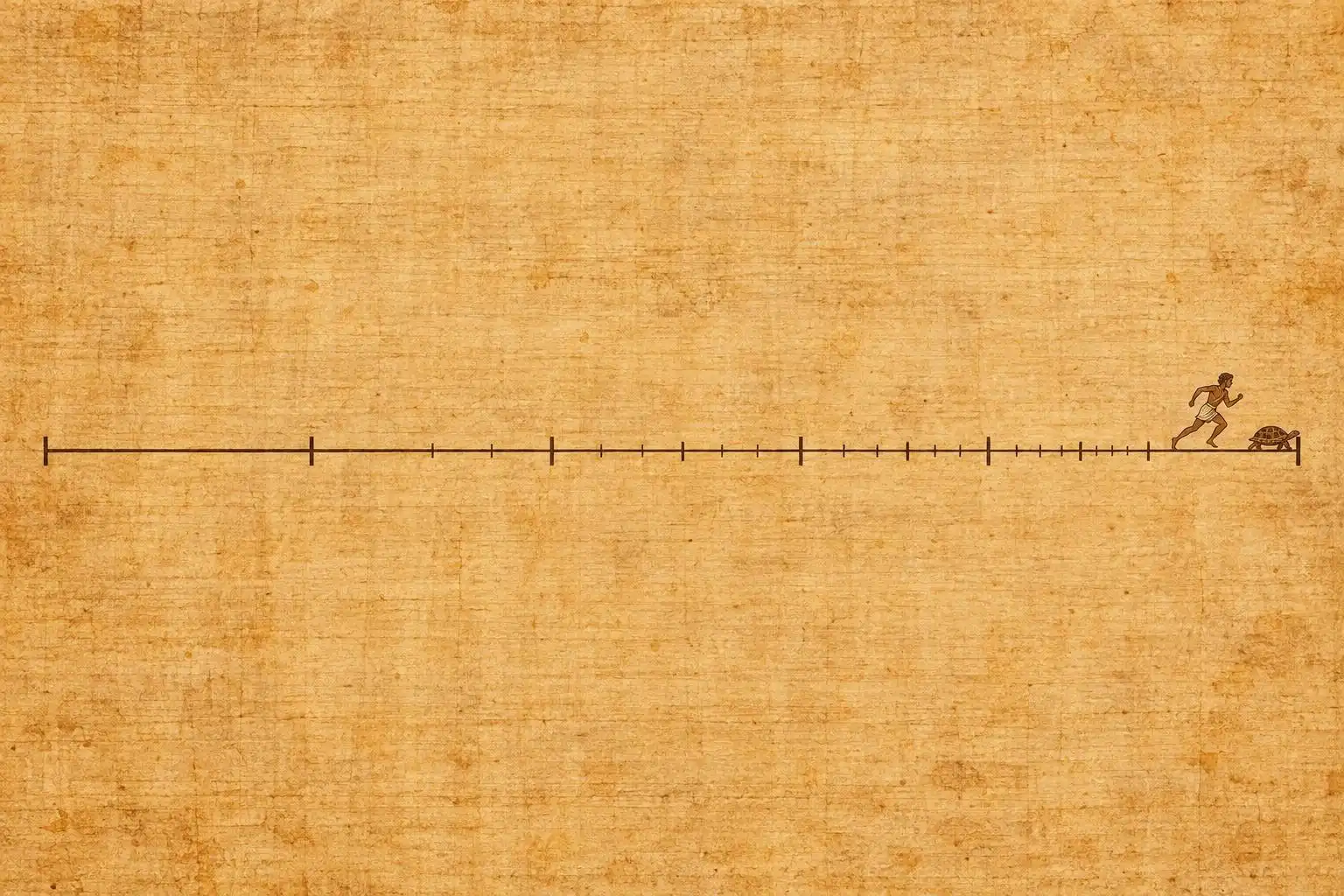
The Achilles argument gives the division a second runner. Achilles grants a tortoise a head start. By the time he reaches where the tortoise began, it has moved on. By the time he reaches that new position, it has moved on again. Each remaining gap is smaller, but the sequence of places Achilles must reach has no last member before the catch.
Of course Achilles catches the tortoise if he runs faster. The argument does not need to deny what happens on the track. It asks what follows when the chase is described as an endless succession of prior arrivals. A description that divides a journey without limit seems to have turned an uncomplicated overtake into something that cannot occur.
What an Infinite Division Does Not Prove
A familiar answer is that infinitely many shrinking distances can have a finite total. Halves of halves do not add up to an endlessly long track. If the runners’ speeds are constant, the time intervals in the Achilles chase shrink too, and their sum can be finite. This answers the claim that an infinite number of divided stages must require an infinite amount of time.
It does not settle every question Zeno has raised. Are the stages independently existing tasks, each of which must be completed, or are they ways we choose to mark a continuous motion? Does passing through infinitely many points amount to doing infinitely many separate things? The calculation tells us the total distance and time. It does not, by itself, tell us which description of the runner’s activity Zeno’s opponent is entitled to use.
Aristotle takes a different route against the arrow argument. As he reports it, an arrow in flight occupies a space equal to itself at each instant; at an instant, it is not moving from place to place. If time is made up of such instants, how can the arrow ever move? Aristotle’s reply challenges that final assumption: time is not composed of indivisible “nows” in the way a wall might be composed of bricks. Motion is not something we should expect to find within an instant.
The Point Before the Start
It is tempting to give Zeno a tidy role: he posed puzzles, and later thinkers solved them. But the evidence will not quite support that clean story. We have Aristotle’s reports of the motion arguments, Plato’s portrayal of Zeno’s purpose, and a few quoted stretches of the attack on plurality. They do not amount to a surviving treatise whose aims we can check from beginning to end.
Return, then, to the runner at the starting line. Zeno asks us to point to the first stretch she crosses. Divide it, and there is a shorter stretch before its end; divide that, and the demand recurs. We can watch her run. We can measure where she arrives. The question pressed upon her opponent is narrower and harder: when the track permits division without a first step, what exactly did she have to do first?



Leave a Reply
You must be logged in to post a comment.