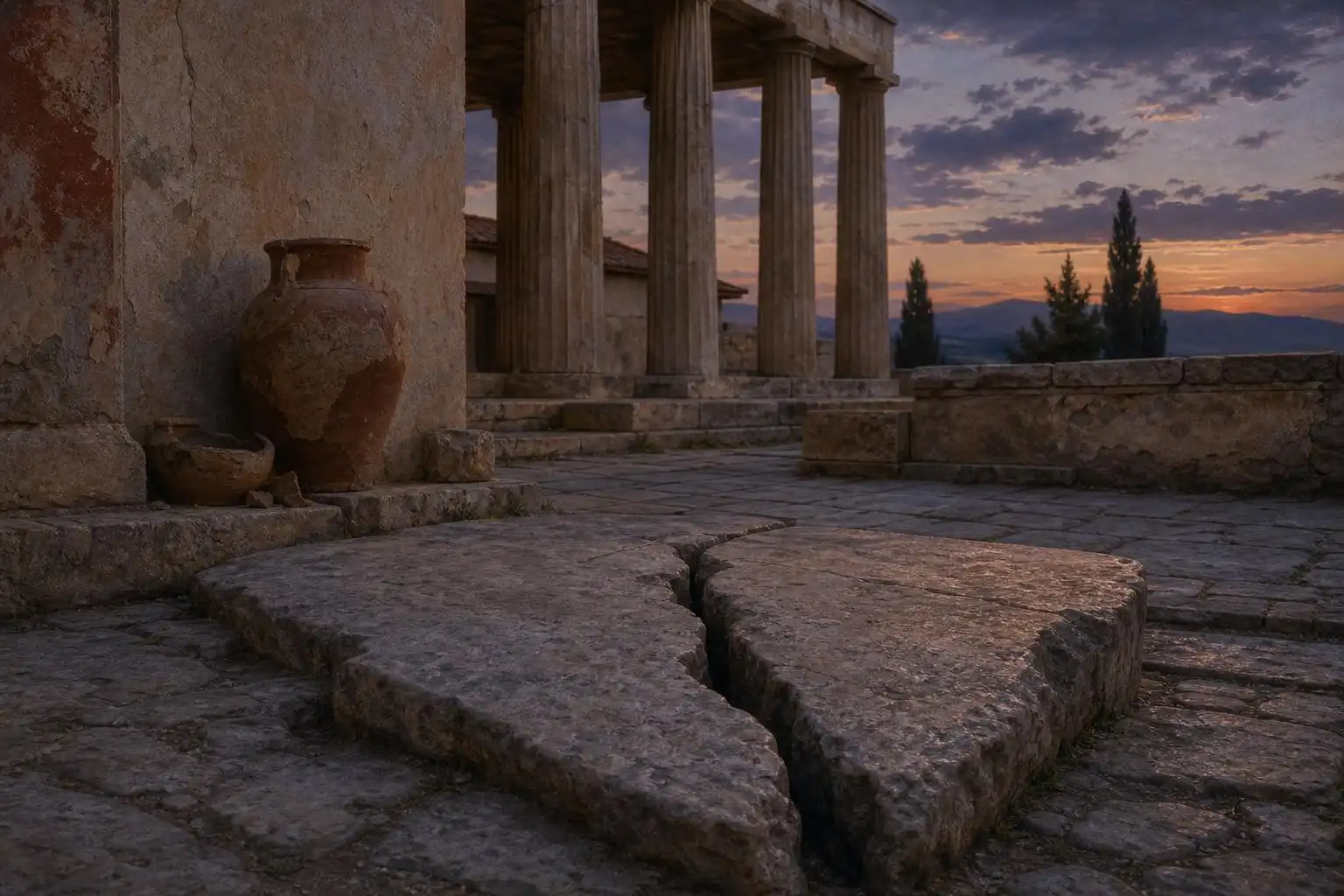

A stone breaks in two. Each piece can break again, and each new piece after that. Does the cutting go on forever? Democritus answered no. At some point, he held, one reaches bodies too small to divide: atoms, from the Greek atomos, “uncuttable.” They move through empty space, collide, and form the things we see.
It is an arresting picture, but the question it answered was harder than a puzzle about smallness. How could anything move if there were no empty place to move into? And how could emptiness exist at all? For Democritus and the earlier atomist Leucippus, explaining an ordinary event—a stone falling, a person walking—meant taking a stand on what is and what is not.
Making Room for Motion
Parmenides had pressed a severe argument against change. What is cannot come from what is not; what is not cannot even be thought or spoken of as something. The world of generation, destruction, and motion seemed to lose its footing. Later thinkers could reject his conclusion, but they could not easily ignore the demand behind it: explain change without making something arise from nothing.
The atomists’ answer was to deny that bodies themselves come into being or perish. Atoms persist. What begins or ends is a temporary arrangement of them. A living creature, a flame, a crumbling wall: each is a configuration with a history, not a new substance summoned out of nonexistence.
But persistent bodies need somewhere to move. Aristotle reports that Leucippus and Democritus called the solid atoms “what is” and the void “what is not”—then insisted that the void exists no less than bodies do. This is not a simple surrender to Parmenides. It is a deliberate strain on his vocabulary. Emptiness is not a body, yet without it no body could change its place.
What the Atoms Can Explain
No complete work by Democritus survives. Much of the physical theory reaches us through later writers, especially Aristotle, who often describes it while arguing against it. That makes the account both precious and hazardous: a critic may preserve an opponent’s claim accurately while arranging it around his own questions.
In Aristotle’s account, atoms differ in shape and in how they are arranged. He compares them to letters: the same characters can make a different sequence when their order changes. Turn a character, and its orientation changes too. The comparison helps explain how a limited set of enduring constituents could produce a world of unlike objects without those constituents acquiring every quality the objects display.
The atoms were not tiny colored pebbles, each already tasting sweet or bitter. Their differences were primarily structural; the qualities familiar to us arose through their combinations and effects. Later testimony describes atoms hooking together or becoming entangled, but we should not mistake every vivid detail in a later account for a line preserved from Democritus himself.
Nor should we picture a handful of atoms sitting in a small vessel. The ancient atomists posited innumerable atoms in an unbounded void. Accounts of their cosmology describe bodies gathering into whirls and worlds forming through motion and collision. Here, too, reconstruction matters: the outlines survive more securely than the course of any particular world-making process.
Sweetness by Convention
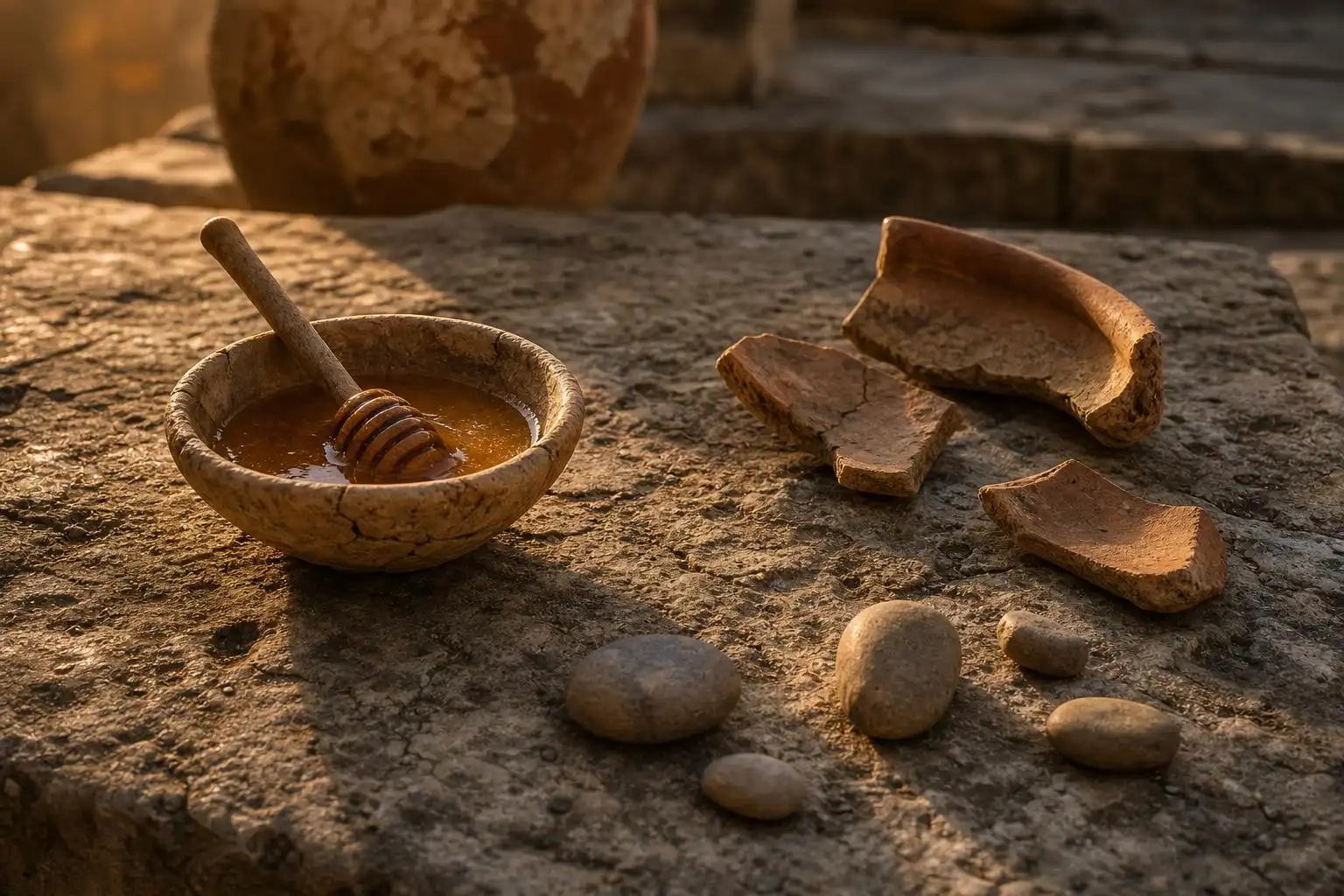
A fragment attributed to Democritus makes the distance between appearance and explanation startlingly sharp: “By convention sweet, by convention bitter, by convention hot, by convention cold, by convention color; in reality atoms and void.” The Greek nomōi, rendered “by convention,” can suggest what holds according to usage or custom. The line is not saying that honey cannot taste sweet. It asks what sweetness belongs to when honey is tasted.
If atoms themselves have no sweetness, then sweetness cannot be a basic ingredient hidden inside honey. It belongs to an encounter between an object and a sensing body. What appears immediately to us is therefore not, simply as it appears, a description of the world’s underlying constitution.
That conclusion has a cost. We do not see atoms or the void. We see colors, feel heat, and taste sweetness—the very experiences the theory refuses to treat as ultimate. How can a thinker use the senses to discover a reality that the senses do not disclose directly?
The Mind and Its Witnesses
Another fragment distinguishes a “dark” kind of knowledge associated with the senses from a “genuine” kind associated with thought. It is tempting to turn this into a clean victory for reason: abandon sight and taste, infer the atoms, and be done. Democritus’ surviving words resist that tidy ending.
Galen preserves a remarkable exchange in which the senses address the mind: “Poor mind, do you take your evidence from us and then try to overthrow us? Your overthrow is your fall.” The wording comes to us through a later author, but the objection is unmistakable. Thought cannot simply dismiss the testimony from which it began. To argue beyond appearances is not to cease depending on them.
We cannot recover the full argument in which Democritus set that exchange. Perhaps he meant to mark a limit on skepticism; perhaps he was dramatizing a difficulty his own account could not wholly settle. The fragments do not decide between those readings. They leave us with a mind claiming to know atoms and void, and senses asking it to remember who first gave it anything to explain.



Leave a Reply