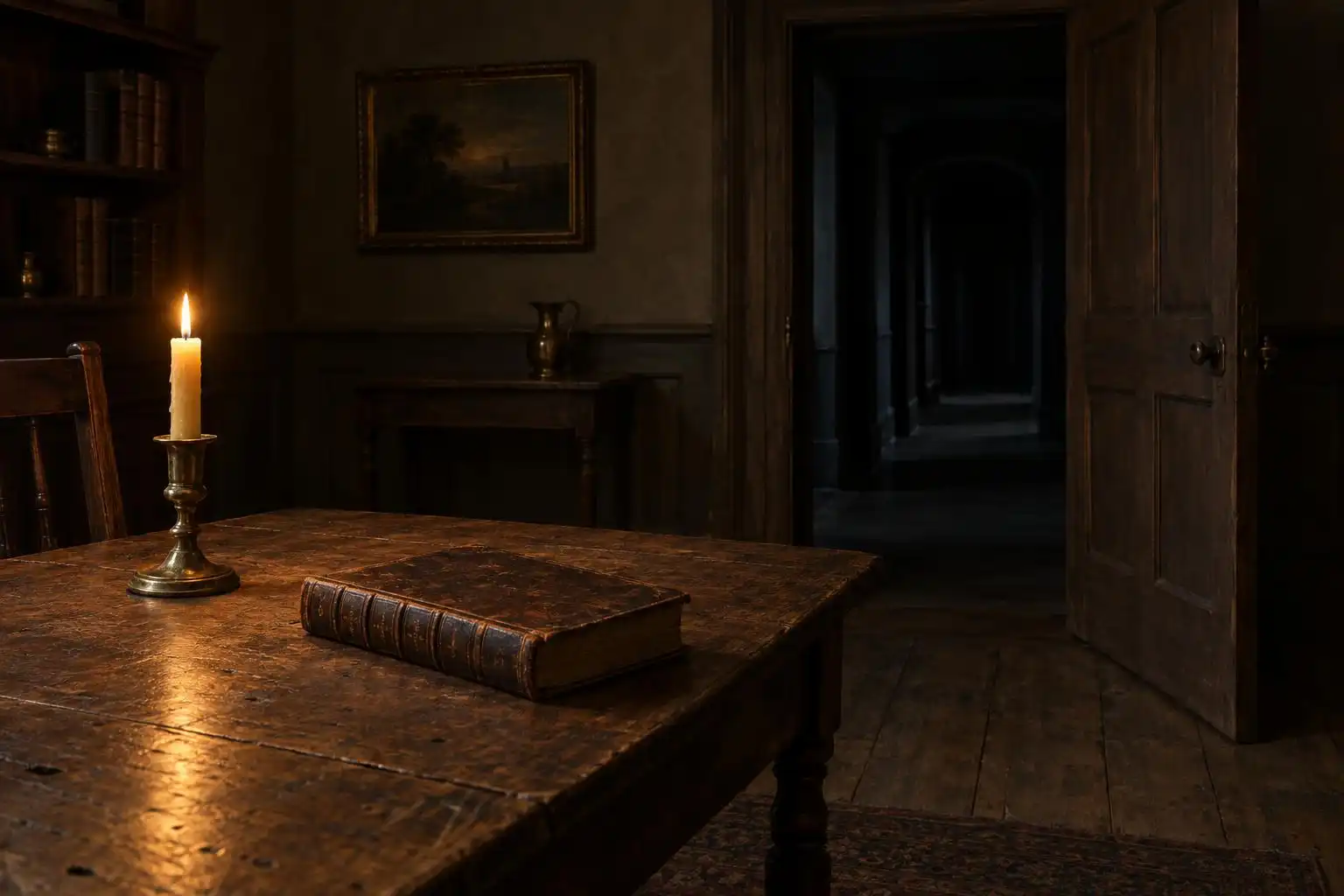

Leave a book on a table and walk out of the room. Does the book remain there? George Berkeley’s answer is yes. That can be surprising, since he also argues that there is no material substance: no mind-independent stuff underlying the colours, shapes, and textures we encounter. His claim is not that books vanish when we turn away. It is that we have mistaken what it means for a book to exist.
The Difference Between a Book and Material Substance
Berkeley begins with ordinary objects as we experience them. A book has a visible shape and colour; we can feel its weight and the texture of its pages. These qualities are what Berkeley calls ideas: things perceived by a mind. To say that the book exists is, on his account, to say that such ideas occur together in a stable, orderly way.
His target is a further claim. Philosophers often suppose that, behind the qualities we perceive, there is an unperceived material substance that has or supports them. Berkeley asks what this addition explains. If we take away every perceivable quality of the book, what is left for the supposed substance to be? Calling it a “support” for qualities does not yet tell us what it is or how it supports them.
Berkeley is not simply arguing that we cannot see through the book’s cover to its hidden material core. His challenge is more basic: the qualities offered as evidence of matter are all perceived qualities. We need an argument for moving from them to something wholly unlike them.
Why Shape Does Not Escape the Argument
One tempting reply draws a distinction between two kinds of qualities. Colours and tastes might depend on perceivers, while shape, size, and motion belong to objects as they are in themselves. A book may look lighter in one room than another, but surely it has a definite shape whether anyone sees it or not.
Berkeley presses the same difficulty against shape. An object looks small from a distance and large up close. A surface may feel smooth to one hand and rough to another. We can describe these variations, and we can measure objects by agreed procedures. But the shape or size as perceived remains an idea. It cannot, Berkeley argues, be peeled away from perception and installed in an unperceived substance.
His challenge is not that measurements are useless. We can still agree that a book is twenty centimetres tall. The question is what such agreement establishes. It helps us predict and coordinate experiences; it does not, by itself, establish a material object existing outside every mind.
Could Matter Cause Our Experiences?
A defender of matter might concede that we perceive only ideas, then propose that material objects cause those ideas. The book itself would remain unperceived, but it would explain why we see and touch a book.
Berkeley doubts that this is an explanation. In A Treatise Concerning the Principles of Human Knowledge, he argues that even if we granted material bodies, we would still need to explain how they produce ideas in a mind. Saying “matter causes perception” gives a name to the connection without making it intelligible. He also notes that dreams show we can have sensory experiences without the material objects they seem to present.
That point needs careful handling. Dreams do not prove that waking books are unreal. Nor does our inability to see a cause prove that it does not exist. Berkeley’s narrower claim is that matter has not earned the explanatory role assigned to it. If the immediate objects of experience are ideas, and an alleged material cause remains both unperceived and unexplained, why introduce it?
The Book in the Empty Room
Berkeley’s alternative begins with a distinction between ideas and spirits. Ideas are perceived; spirits are active perceivers. When I leave the room, the book does not depend on my continuing to perceive it. Other people may see it, and I can return to find it where I left it.
What if nobody is in the room? Berkeley appeals to God. The world’s order and persistence depend on an infinite spirit, not on an unperceived material substrate. This is sometimes shortened to “God sees the book.” That phrase is convenient but potentially misleading: Berkeley does not need God to undergo human sensations of colour and touch. God knows and sustains the orderly world in which those sensations are available to finite minds.
The appeal to God carries considerable weight in the theory. Without it, Berkeley would struggle to account for the book’s continued existence when no human being perceives it. A reader who rejects his theology may therefore reject his solution. But that objection differs from saying he believes objects disappear whenever we close our eyes. He explicitly intends to preserve their persistence.
What the Argument Changes
Berkeley’s view leaves much of everyday life intact. Books can be lost, found, measured, and damaged. Our experiences are not generally under our voluntary control: I cannot make the book disappear by wishing it away. The regularity of what we perceive is part of what his account must explain.
What changes is the philosophical account of that regularity. The materialist says persistent objects are made of mind-independent substance that causes our perceptions. Berkeley says the familiar book is a stable part of an ordered world of ideas, sustained by God and encountered by perceiving minds. His argument does not settle the dispute merely by pointing out that we perceive through our senses. It asks whether the supposed substance behind experience explains anything that the ordered experience itself cannot.


Leave a Reply