
Anaximander left us almost no words we can confidently call his own. Yet one surviving passage seems to make a startling claim: things must pay one another a penalty for their injustice. What could injustice mean before there are people to commit it? To approach that question, we have to begin with the distance between Anaximander’s world and the witnesses who describe it.
A Sentence Preserved at a Distance
Anaximander lived in sixth-century BCE Miletus, on the coast of Asia Minor. Centuries later, the commentator Simplicius preserved an account of his thought drawn from the earlier philosopher Theophrastus. In that account appears the sentence usually treated as Anaximander’s sole surviving fragment. Coming-to-be and passing-away occur “according to necessity,” and things “pay penalty and retribution to one another for their injustice according to the ordering of time.”
Where Anaximander’s own wording begins and ends is disputed. Simplicius even remarks on the passage’s poetic language, but his report moves between quotation and explanation without modern quotation marks. We cannot open Anaximander’s book and check. The fragment is precious precisely because it is so exposed: a few words carried through several hands, surrounded by interpretations already made on our behalf.
What Has No Boundary?
Ancient reports say Anaximander identified the source of things as the apeiron, commonly translated “the boundless” or “the indefinite.” The word does not settle whether he meant something infinite in extent, something without a fixed character, or both. Calling it a substance can help, but it risks making the apeiron sound like a familiar material that happens to fill a very large space.
The contrast with Thales, who was later said to make water fundamental, is instructive. If the source were water, how could it also give rise to its apparent opposite, fire? Aristotle presents a version of this difficulty when discussing Anaximander, though we must be careful not to mistake Aristotle’s argument for Anaximander’s own. An indefinite source might avoid granting one familiar element an unfair victory at the beginning.
That possibility makes Anaximander’s proposal bolder than a search for the earliest ingredient. The world contains opposed conditions—hot and cold, wet and dry—none of which simply stays in command. The source from which a world arises may therefore be unlike any condition that takes its turn within it. How much of this reasoning belongs to Anaximander, and how much to those who reconstructed him, remains uncertain.
The Injustice of Taking a Turn
The fragment’s language suggests a world in which things exceed their allotted place and later answer for it. Summer heat yields to winter cold; wet ground dries and is wet again. These are useful ways to hear the passage, not examples Anaximander himself supplied in the words we possess. Nor does “injustice” require us to imagine the universe passing moral judgment on weather.
Notice that the penalty is paid “to one another.” On one reading, opposed powers repay what they have taken from their opposites. On another, the language concerns individual things that emerge and perish, returning to the source from which they came. Even the grammar leaves room for argument about what, exactly, owes the debt. A neat doctrine of cosmic balance can conceal that difficulty rather than resolve it.
Time, at least, is not incidental. Retribution comes “according to the ordering of time”: a power’s ascendancy is temporary, and its limit appears not as an external command but in what follows. Whether this is Anaximander’s account of seasonal change, of the birth and death of worlds, or of coming-to-be more generally, the passage describes an order that does not need a judge to announce each verdict.
An Earth With Nothing Beneath It
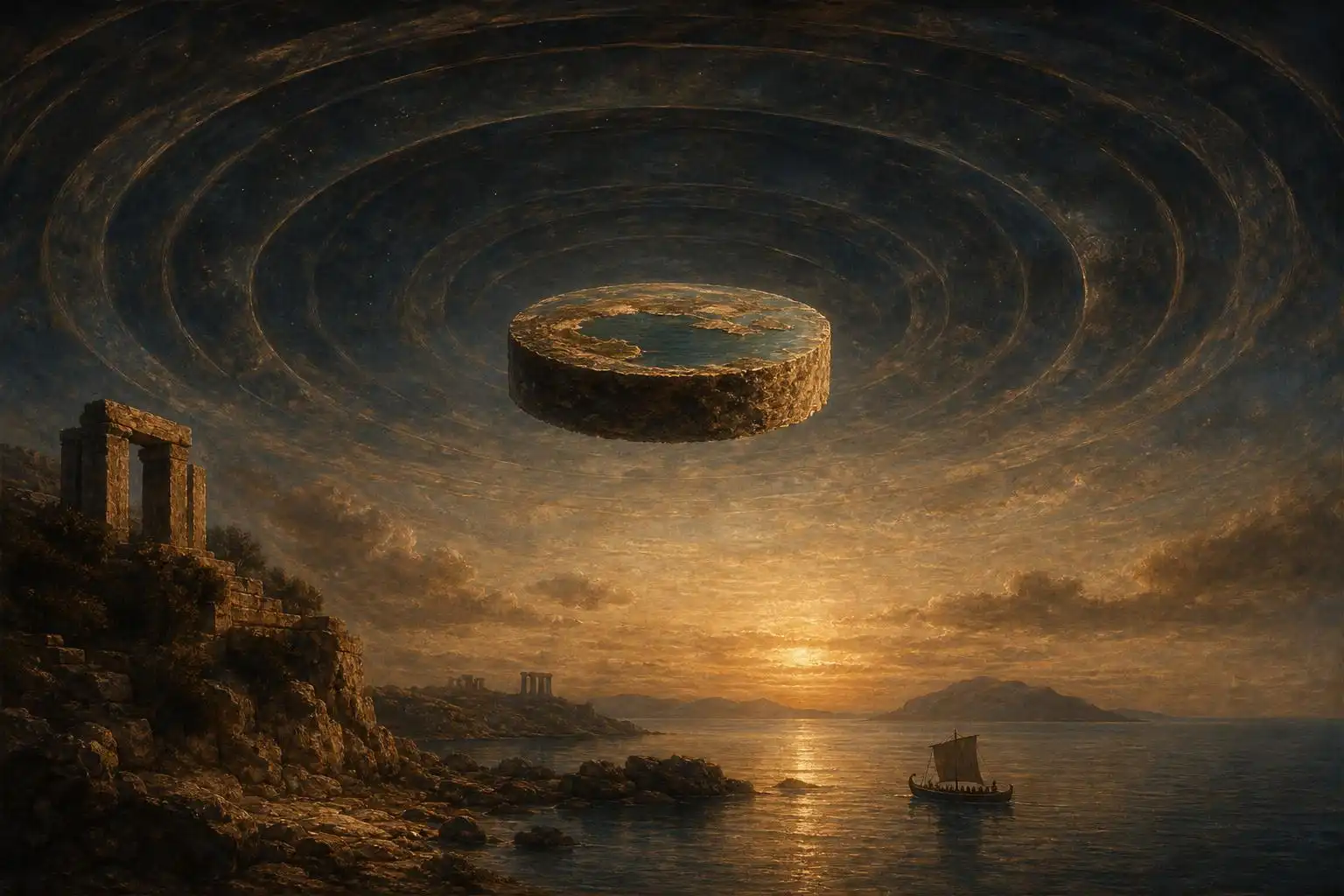
Anaximander’s reported cosmology offers another glimpse of his willingness to refuse an expected support. Ancient witnesses describe the earth as cylindrical, resting at the center without anything holding it up. Why does it not fall? Aristotle attributes to Anaximander the answer that, being equally related to what surrounds it, the earth has no reason to move in one direction rather than another.
The earth in this picture is neither a modern globe nor a disk balanced on an invisible pillar. Its stillness receives an explanation through symmetry. We should not assume that Aristotle has preserved Anaximander’s exact reasoning, but the reported answer is remarkable: instead of asking what holds the earth up, it asks why any direction should win out.
Other reports describe heavenly fires enclosed in rings, visible through openings, though their measurements and details vary across the sources. Such accounts are tempting to assemble into a complete model. They are also a reminder of how little of that model reaches us in Anaximander’s voice. We can trace an ambition to explain the arrangement of the heavens without pretending that every surviving diagram fits cleanly together.
What the Witnesses Cannot Settle
Anaximander is often made into a confident founder of scientific cosmology, or into the author of a single elegant law of balance. Both portraits draw on something real in the testimony. Both become too smooth when they erase the gaps between a sixth-century thinker, a later history of philosophy, Aristotle’s arguments, and Simplicius’s commentary.
The fragment resists a final smoothing. Its things arise, press against one another, and pay what is due in time; but we cannot be sure whether the debt belongs to opposites, to perishable beings, or to both. The ancient sentence gives us an order of repayment without naming every debtor. That omission is not ours to repair by making the world simpler than the surviving words allow.



Leave a Reply