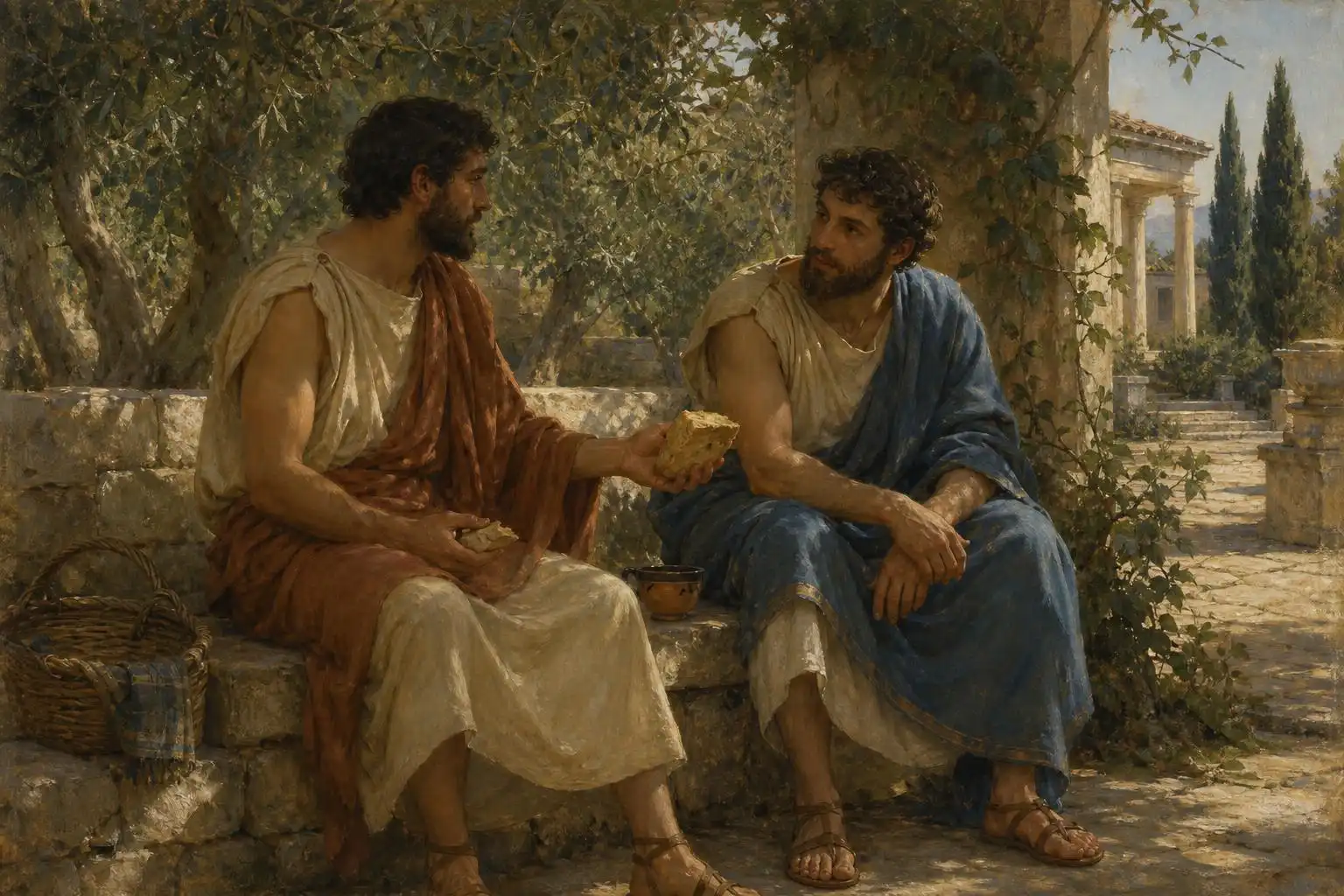

Epicurus is often made to sound like a man who solved life by wanting less. Eat simply, ignore status, stop fearing death: the advice is attractive, especially when it can be compressed into a list. But it leaves out a stubborn feature of his philosophy. The thinker who urged independence from unnecessary desires also regarded friendship as indispensable to a good life. Other people are not an optional extra in his account of pleasure.
That creates a real question. Friends can disappoint us, leave us, or die. If Epicurus wanted freedom from anxiety, why make our happiness depend on relationships we cannot control?

What Epicurus Meant by Pleasure
Epicurus called pleasure the goal of life, but he did not mean a continuous succession of treats. In his Letter to Menoeceus, he describes the end as freedom from bodily pain and mental disturbance. The familiar terms are aponia and ataraxia. A modest meal can be satisfying; an elaborate one is no help if acquiring it makes life fearful or dependent.
This is not an argument against enjoying good food when it appears. It is an argument against needing it. Epicurus thought desires should be examined by asking what happens when they go unmet. Some answer to basic needs. Others grow with every attempt to satisfy them. A person who requires prestige, for example, has handed the terms of their contentment to an audience.
It would be easy to put friendship in that second category. Affection makes us vulnerable, and vulnerability seems a poor bargain for someone seeking tranquillity. Epicurus thought the bargain looked different once we understood what solitude costs.
The Limit of Self-Sufficiency
Epicurean self-sufficiency means being able to live well without wealth or luxury. It does not mean being able to live well without anyone. Principal Doctrine 27 says that, of all the things wisdom provides for a happy life, the greatest is friendship. That is an unusually strong claim for a school regularly caricatured as a retreat from human obligations.
Why give friendship such importance? One answer is security. A friend can offer help in illness, scarcity, or danger. Yet Epicurus’s Vatican Saying 34 makes a finer point: what matters is not so much the assistance friends give as the confidence that they will give it. Trust changes how a person lives before a crisis arrives. It loosens the grip of anticipation.
Security here is more than a stockpile of favors owed. If I must constantly calculate whether someone will come through for me, the relationship supplies another source of worry. A friend is someone whose concern I can reasonably trust, and for whom I have concern in return. Tranquillity is not produced by treating people as equipment.
Can Friendship Be More Than Useful?
Epicurus does not conceal friendship’s practical beginnings. Vatican Saying 23 says that friendship arises from usefulness, while also insisting that it is chosen for its own sake. Those claims are sometimes presented as an embarrassing contradiction. They are better read as a distinction between how a relationship begins and what it becomes.
People may first draw close because they share food, shelter, conversation, or protection. None of that prevents them from coming to value one another as particular people. A friendship that never develops beyond an exchange of advantages remains precarious: the moment a better offer appears, its supposed bond disappears. Epicurus’s insistence that friendship is worth choosing for itself gives the relationship a durability calculation alone cannot provide.
This does not turn Epicurus into an advocate of unconditional self-sacrifice. His account of friendship remains part of an ethics of pleasure. The interesting claim is that caring for someone need not be a departure from living pleasantly. Shared life, mutual confidence, and affection are among the ways such a life is made possible.
Trust Requires a Social World
Epicurus’s account of justice helps explain why friends cannot build peace by simply ignoring everyone else. In Principal Doctrine 31, justice is an agreement not to harm or be harmed. The doctrine does not propose a single law valid in identical form everywhere; it asks what arrangements allow people to live together without fear.
A friendship needs that wider setting. Promises mean little where betrayal carries no weight, and a garden wall is thin protection if every stranger is a threat. Epicurean tranquillity therefore has social conditions, even if Epicurus was skeptical of pursuing power and public distinction as routes to happiness. Withdrawal from competitive ambition is not withdrawal from the problem of how people treat one another.
Nor does friendship abolish risk. No agreement can guarantee that a friend will live, remain nearby, or never change. Epicurus offers no technique for making attachment painless. He asks instead whether avoiding every possible loss would leave us with a life worth securing.
A More Demanding Kind of Simplicity
There is something bracing about the limits of Epicurean independence. A person can learn to be content with plain food; they cannot manufacture mutual trust by an act of private will. Friendship takes time, attention, and the willingness to be answerable to someone else. It is simple only by comparison with the restless pursuit of status.
The usual picture of Epicurus gets one thing right: he wanted people to stop making themselves miserable over what they do not need. But friendship was not among the things he proposed cutting away. His quieter claim is also the harder one: pleasure requires us to need less from the world without pretending we need no one in it.


Leave a Reply