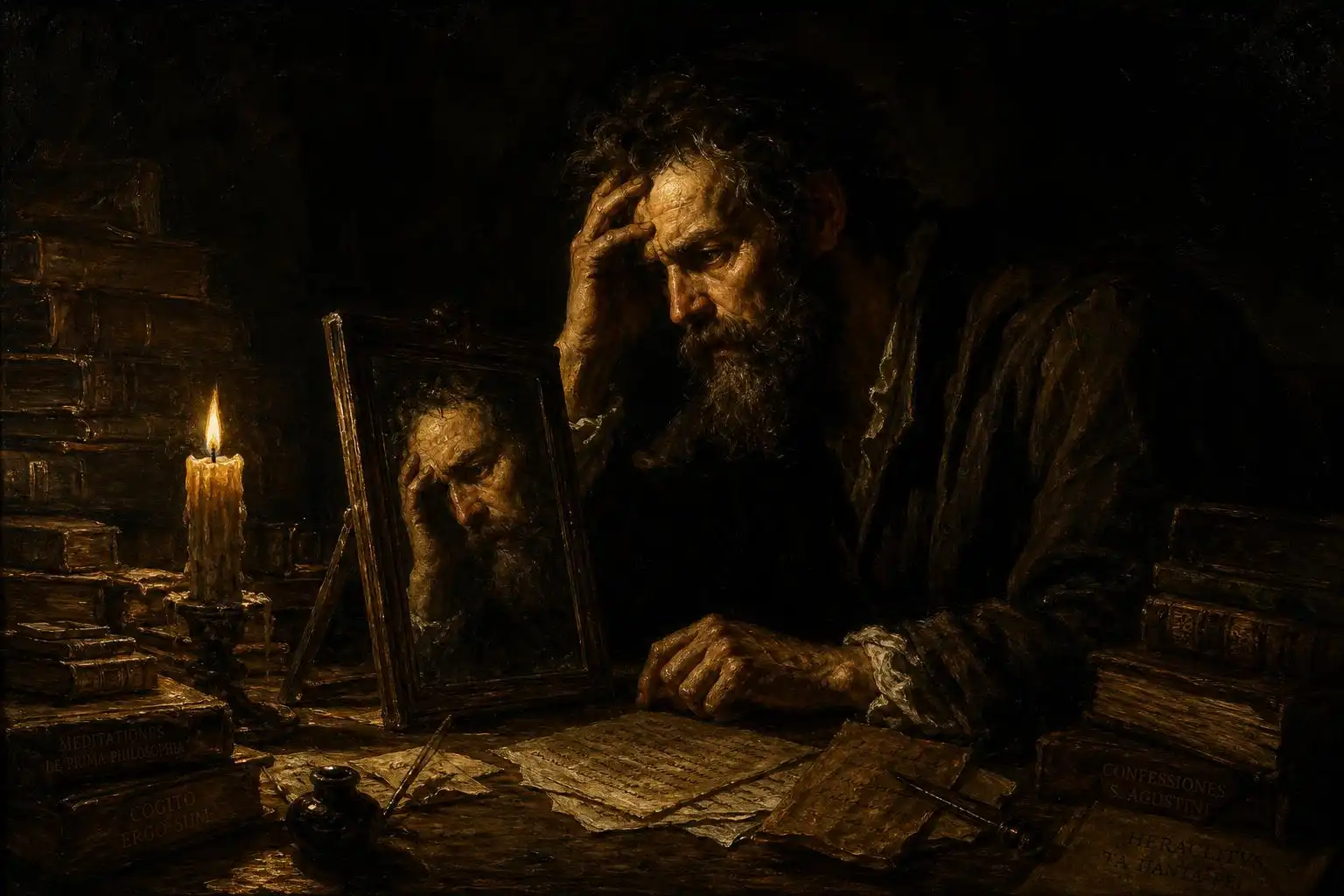

Suppose you are reading these words right now. You feel fairly confident of that. But how do you know? Your eyes might be deceiving you. Your brain might be generating the experience of reading while you lie unconscious in a hospital bed, or float in a vat of nutrients wired to a supercomputer. The very faculties you would use to rule out these possibilities — perception, memory, reason — are exactly the faculties under suspicion. The sceptic’s challenge is not merely irritating. It is structurally elegant: you cannot step outside your own mind to check whether your mind is working.
This is one of the oldest problems in philosophy, and it has never been solved to everyone’s satisfaction. What has changed, across two and a half millennia, is the shape the problem takes — who is doing the doubting, what they doubt, and what they think follows from the doubt. Tracing that arc reveals something important: the question is not just about knowledge. It is about what kind of creature a human being is, and what we owe each other when certainty is unavailable.
The Greeks Who Stopped Asserting
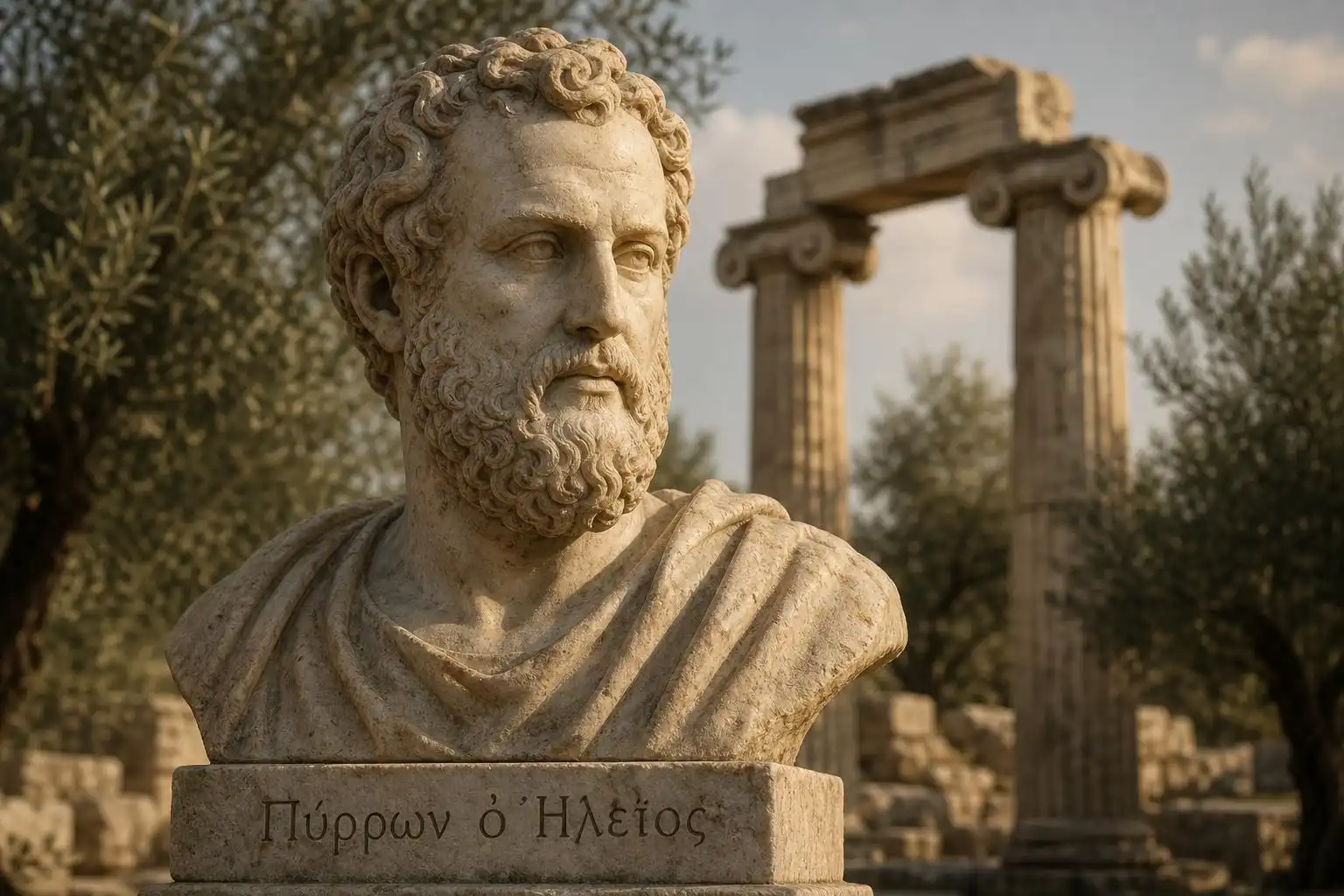
The story usually begins with Pyrrho of Elis, who lived in the fourth and third centuries BCE and left no writings of his own. What we know of him comes mostly through the much later compendium of Sextus Empiricus, written around the second century CE, which means we are already dealing with a tradition rather than a single voice. That is fitting, because Pyrrhonism was always more a practice than a doctrine.
The Pyrrhonists noticed something that seems obvious once stated but is surprisingly hard to shake: for almost any claim, you can find an equally compelling counter-claim. Is honey sweet? It tastes sweet to the healthy person and bitter to the jaundiced one. Is the tower round or square? It looks round from a distance and square up close. Is this action just? One culture says yes, another says no. When you line up the arguments on each side and they seem genuinely balanced — a state the Pyrrhonists called isostheneia, equal strength — what should you do? Their answer was to suspend judgment, to neither assert nor deny. They called this suspension epoché.
What is remarkable is what they claimed follows from this suspension: not anxiety, but tranquility. The word they used was ataraxia, undisturbedness. The person who stops straining after certainty, who releases the grip of “I must know,” finds a kind of peace. This makes Pyrrhonism one of the few philosophical positions that treats radical doubt as a therapy rather than a catastrophe.
But a question immediately presses: how does the Pyrrhonist get through the day? If you suspend judgment about whether the fire is hot, do you not get burned? Sextus has an answer: the sceptic follows appearances (phainomena) and the customs of their community without asserting that these appearances reveal how things really are. You pull your hand from the flame not because you have judged it to be truly hot, but because it appears hot and that appearance guides action. This is a subtle and genuinely interesting position, though critics have always wondered whether it is coherent or merely a comfortable evasion.
Descartes and the Weaponisation of Doubt
For roughly fifteen centuries, scepticism was discussed, refined, and occasionally revived, but it was not the central problem of European philosophy. Medieval thinkers were generally more interested in reconciling reason with faith than in entertaining the possibility that reason itself might be broken. The sceptical tradition survived as a reference point, not an obsession.
That changed dramatically in the seventeenth century, when René Descartes sat down — famously, by a fire, in a dressing gown — and decided to doubt everything he could possibly doubt. His goal was not tranquility. It was the opposite: he wanted to find something so certain that no doubt could touch it, and to rebuild knowledge on that foundation. He was doing for philosophy what the new science was doing for nature: clearing the ground and starting fresh.
Descartes’ method was to treat doubt as a tool. He did not need to believe his senses were deceiving him; he only needed to notice that they could be. That possibility was enough to suspend their authority. He imagined an evil demon of supreme power and cunning whose sole purpose was to deceive him — making him believe in an external world that did not exist, in mathematical truths that were false, in memories that had never happened. If such a demon were possible, what could survive?
His famous answer was the cogito: cogito, ergo sum, I think, therefore I am. Even if the demon is deceiving me, there must be something being deceived. Doubting is a form of thinking, and thinking requires a thinker. The one thing the demon cannot take away is the bare fact of my own existence as a thinking thing.
From this slender foothold, Descartes tried to rebuild the entire edifice of knowledge — through a proof of God’s existence, through the claim that a non-deceiving God would not permit systematic perceptual error, and so on. Most philosophers today think the reconstruction fails. The proofs of God’s existence are disputed, and there is a nagging circularity: Descartes uses reason to prove that reason is reliable, which assumes the very thing in question. But the cogito itself has proven remarkably durable. It identified something important: the first-person perspective has a kind of immediacy that third-person observation lacks. I may be wrong about the world, but I cannot be wrong that there is a perspective from which the world appears.
Hume and the Dissolution of the Self
David Hume, writing in the eighteenth century, accepted the sceptical challenge more honestly than Descartes and drew more radical conclusions. Where Descartes found a bedrock self — a thinking substance — Hume looked inward and found nothing of the kind.
When Hume tried to catch himself in the act of being a self, he reported finding only a “bundle or collection of different perceptions” — impressions of heat, cold, pain, pleasure, thoughts, feelings — succeeding one another with great rapidity. There was no persistent observer behind the stream, no Cartesian “I” sitting in the theatre of the mind watching the show. The self, on this view, is a fiction we construct from the flow of experience, not a substance we discover.
This matters for scepticism because it radicalises the problem. Descartes thought he had secured at least one certainty: the existence of the thinking self. Hume denies even that. But Hume’s scepticism goes further still. He argues that we have no rational basis for our belief in cause and effect. When we see one billiard ball strike another and the second move, we do not perceive the causal connection — we perceive two events in sequence. The idea that the first caused the second is a habit of mind, a psychological expectation built up from repeated observation. It is not a logical necessity. We cannot prove that the future will resemble the past; we simply expect it to, because it always has. This is the famous “problem of induction,” and it remains unsolved.
Hume’s own response to his scepticism was something close to the Pyrrhonist one: nature saves us. We cannot help but believe in causation, in the external world, in personal identity, because these beliefs are built into how the human mind works. Philosophy can reveal their lack of rational foundation, but it cannot dislodge them. When Hume left his study and played backgammon with his friends, the sceptical doubts dissolved. They only returned when he sat down to philosophise again. He found this not entirely comfortable, but he found it honest.
Kant’s Attempted Rescue
Immanuel Kant read Hume and, as he put it, was woken from his “dogmatic slumber.” His response, developed in the Critique of Pure Reason of 1781, was one of the most ambitious in the history of philosophy: he tried to show that the sceptical challenge rests on a mistake about the relationship between mind and world.
The traditional picture — which both Descartes and Hume shared — is that the mind receives impressions from a world that exists independently of it, and knowledge consists in the mind accurately representing that world. The sceptic then asks: how do you know your representations are accurate? Kant proposed to invert the picture. The mind does not passively receive a ready-made world; it actively structures experience. Space, time, causation — these are not features of things as they are in themselves, but forms that the mind imposes on the raw material of sensation. We never encounter the world “as it is in itself” (das Ding an sich, the thing in itself); we only ever encounter the world as structured by our cognitive apparatus.
This move — called the “Copernican revolution” in philosophy, because it put the mind at the centre rather than the world — has a surprising consequence for scepticism. If space, time, and causation are conditions of experience rather than features of an independent world, then we can be certain of them a priori, before any experience. We do not need to worry that future experience will overturn them, because they are what make experience possible in the first place. Hume’s problem of induction is dissolved, not solved: the question “why should the future resemble the past?” assumes we could have experience of a causation-free world, but Kant denies that is even coherent.
The cost of this rescue is significant. We gain certainty about the world of experience, but we permanently lose access to the world as it is in itself. We are, in a sense, locked inside the structure of our own cognition. Some later philosophers thought this was just scepticism in a more sophisticated disguise.
The Twentieth Century: Knowledge Without Foundations
By the time philosophy arrived at the twentieth century, the project of finding an unshakeable foundation for knowledge — the project Descartes had launched and Kant had transformed — was under serious pressure from multiple directions.
Ludwig Wittgenstein, in his late work On Certainty (published posthumously in 1969), approached the sceptical problem from an entirely different angle. He noticed that the sceptic’s challenge — “how do you know you have a hand?” — is peculiar because it demands justification for something that is not normally in the space of justification at all. Our most basic certainties, Wittgenstein argued, are not beliefs we hold on the basis of evidence; they are the hinges on which the door of inquiry swings. You cannot doubt everything at once, because doubt itself requires a background of things not doubted. The sceptic who claims to doubt whether there is an external world is not making a super-rigorous philosophical move; they are stepping outside the language game in which “doubt” has meaning.
This is not a refutation of scepticism so much as a diagnosis of it. The sceptic has not discovered that we know nothing; they have produced a sentence that looks like a doubt but functions like a kind of philosophical vertigo — a momentary loss of footing that tells us something about the grammar of knowledge, not about its actual limits.
Around the same time, W. V. O. Quine was arguing that the foundationalist picture was wrong from the start. Knowledge, he said, is not a building resting on certain foundations; it is more like a web or a raft. No single belief is immune to revision in principle, but we revise beliefs piecemeal, holding most of the web steady while we adjust the parts that conflict with experience. There is no Archimedean point outside the web from which to check the whole thing. We are, as the philosopher Otto Neurath put it, like sailors who must rebuild their ship plank by plank while remaining at sea — we cannot haul it into dry dock and start from scratch.
What the Problem Reveals
Two and a half thousand years of sceptical argument have not produced a consensus, and that is worth sitting with rather than apologising for. Philosophy is not always in the business of solving problems; sometimes it is in the business of clarifying what the problem actually is.
What the history of scepticism reveals, when you trace it from Pyrrho to Wittgenstein, is a gradual shift in what the problem is taken to be about. For the ancient Pyrrhonists, it was about how to live well in the face of uncertainty. For Descartes, it was about securing the foundations of the new science. For Hume, it was about the limits of reason and the power of habit. For Kant, it was about the relationship between mind and world. For Wittgenstein and Quine, it was about the grammar of doubt itself — about what it even means to ask for justification.
None of these framings is simply wrong. Each one catches something real. The sceptical challenge is not a single question but a family of questions that share a structure: you are using some faculty or framework to evaluate that same faculty or framework, and the circularity is inescapable. What changes across the centuries is how philosophers decide to live with that circularity — whether they embrace it as liberation (the Pyrrhonists), try to escape it through a self-certifying starting point (Descartes), accept it as a permanent condition (Hume), restructure the terms of the problem (Kant), or dissolve the question by examining its grammar (Wittgenstein).
Perhaps the most honest conclusion is also the most unsettling: we are not in a position to prove that we know anything, and we are not in a position to stop knowing things. We are creatures who form beliefs, revise them, trust some more than others, and act on them — all without a guarantee. The sceptic is right that the guarantee is unavailable. But the pragmatist, the naturalist, and the ordinary person going about their day are also right that the absence of a guarantee is not the same as the absence of knowledge. Living in that gap, without pretending it is closed, may be the most philosophical thing any of us ever does.



Leave a Reply