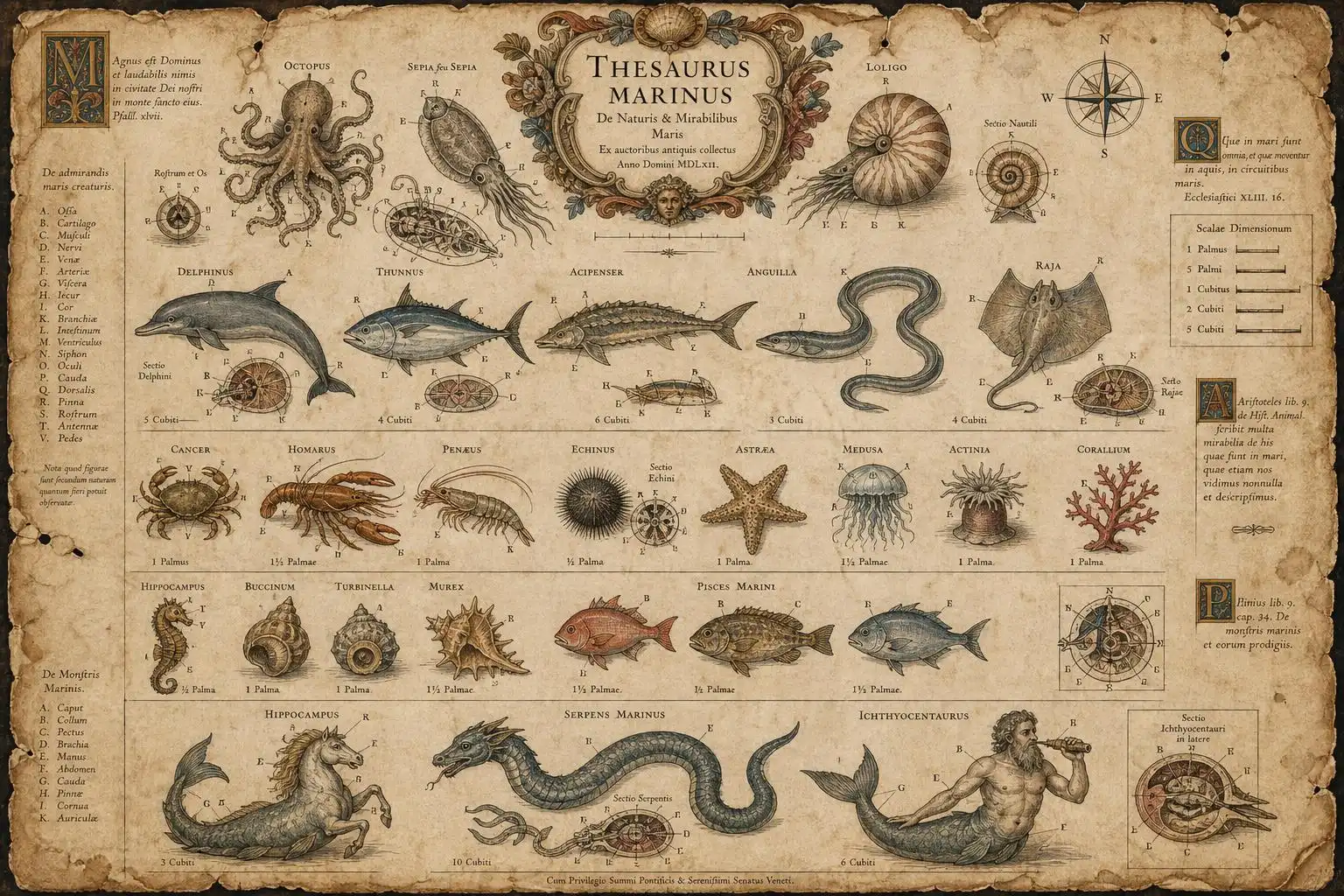

There is a version of Aristotle that most people meet in philosophy courses: the logician of the Categories, the metaphysician of the Metaphysics, the ethicist of the Nicomachean Ethics. He arrives pre-packaged as a system-builder, the man who sorted the world into categories and handed Western thought its scaffolding. This Aristotle is real enough, but he is incomplete in a way that quietly distorts everything else. The Aristotle you do not meet — the one who spent years on the island of Lesbos dissecting fish, cataloguing the reproductive habits of cephalopods, and recording the social behavior of bees — is not a curious footnote to the philosopher. He is, in a serious sense, the philosopher’s foundation.
The biological works — Historia Animalium, De Partibus Animalium, De Generatione Animalium, and a cluster of shorter treatises — occupy roughly a quarter of the surviving Aristotelian corpus. For most of the twentieth century, they were treated by philosophers as an embarrassment: pre-scientific guesswork, best left to historians of biology. That view has been largely abandoned, and rightly so. What the biological works reveal is not a proto-scientist making charming mistakes but a thinker whose deepest philosophical commitments were forged in the encounter with living things. To read the Nicomachean Ethics without having read De Partibus Animalium is to read a conclusion without its premises.
The Form That Does Something
Aristotle’s hylomorphism — his doctrine that things are composites of matter (hyle) and form (morphe) — is usually introduced through tidy examples: the bronze statue, the wax seal, the axe. These are pedagogically convenient but philosophically thin. The statue’s form is its shape; remove the bronze and the shape goes with it. That is not a very interesting theory of form.
The biological works give hylomorphism its real content. In De Partibus Animalium, Aristotle is explicit: you cannot understand an animal’s parts by cataloguing their material constituents. Blood is not just a mixture of elements; an eye is not just a lump of transparent jelly. These things are what they are functionally — they exist for the sake of something. The eye is for seeing; the hand is for grasping. Remove the function and you have, as Aristotle puts it, an eye in name only, the way a painted eye is an eye. A dead man’s hand is not really a hand.
This teleological conception of form — form as the what-it-is-for, the telos — transforms the metaphysics. Form is not a shape imposed on passive matter; it is an organizing principle that makes matter do something, that orients a creature toward its characteristic activities. And this is precisely the concept that drives the Nicomachean Ethics. When Aristotle asks what the ergon — the characteristic function — of a human being is, he is asking the same kind of question he asks about the eye or the hand. The answer, rational activity in accordance with virtue, is not a free-floating ethical claim. It is a piece of the same teleological biology.
The self-help industry has done considerable damage to the concept of eudaimonia, usually translated as “happiness” and treated as a feeling to be cultivated. But eudaimonia for Aristotle is a biological-style concept: it is the actualization of a creature’s form, the full exercise of its characteristic capacities. A knife that cuts well is a good knife. A human being who reasons and acts well — who exercises the virtues that belong to the kind of creature we are — is a flourishing human being. The ethics is downstream of the zoology.
Teleology Without a Teleologist
One of the persistent misreadings of Aristotle’s biology is the assumption that his teleology requires a designer. If the eye is for seeing, surely something or someone designed it that way? Aristotle is quite clear that this is not his view. Nature, he says, acts like a craftsman — but nature is not a craftsman. The telos is immanent in the creature itself, not imposed from outside.
In De Partibus Animalium he is emphatic that the philosopher of nature must give teleological explanations, not because God arranged things this way, but because living things simply are the kind of things that have ends. The swallow builds its nest and the spider spins its web not because they have deliberated about shelter and prey but because their nature is such that these activities are their actualization. Teleology, for Aristotle, is a feature of the biological world, not a theological hypothesis about it.
This matters for how we read his ethics and politics. When Aristotle says in the Politics that the human being is by nature a political animal — zoon politikon — he is making a biological claim. We are the kind of creature whose characteristic form of life requires a polis, a structured community of mutual governance. This is not a claim about divine order or social contract; it is a claim about what kind of animal we are, in the same register as the claim that bees are social insects. The polis is the environment in which human form can be actualized, the way water is the environment in which a fish’s form can be actualized.
The Ladder of Nature and the Continuity of Life
Historia Animalium is, on its surface, a vast descriptive catalogue: the parts, habits, diets, reproductive strategies, and social arrangements of hundreds of animals. It is also, less visibly, a sustained argument about the continuity of nature. Aristotle repeatedly insists that the transitions between kinds of living things are gradual. Between plants and animals there are organisms — he has sponges and sea anemones in mind — that could go either way. Between the various grades of animal there are continuous gradations of complexity, memory, perception, and something approaching intelligence.
This scala naturae, the ladder of nature, is philosophically consequential. It means that the capacities Aristotle identifies in the De Anima — the nutritive soul, the sensitive soul, the rational soul — are not three distinct substances but three levels of functional organization, each incorporating and surpassing the last. Plants have the nutritive soul; animals add perception and desire; humans add reason. But reason does not float free of the animal substrate. It is layered on top of, and deeply entangled with, the perceptual and appetitive capacities we share with other creatures.
This is why Aristotle’s ethics takes habituation so seriously. Virtue is not a matter of knowing the right principles and applying them; it is a matter of training the appetitive and emotional parts of the soul — the parts we share with other animals — so that they reliably respond in ways that accord with reason. The Nicomachean Ethics is, in part, a manual for the domestication of the animal within us. You cannot understand why Aristotle thinks this without understanding that he thinks we genuinely are animals, continuous with the rest of the living world.
What Darwin Saw
It is worth pausing over a remark that D’Arcy Wentworth Thompson, the great translator of Historia Animalium, made in the early twentieth century: that Aristotle was the first great naturalist, and that his achievement was not superseded but transformed by Darwin. Darwin himself, near the end of his life, wrote that Linnaeus and Cuvier had been his gods, but that “they were mere schoolboys to old Aristotle.” This is not mere historical courtesy. Darwin recognized in Aristotle a thinker who had grasped the essential strangeness of the living world: that organisms are organized wholes, that their parts make sense only in relation to their functions, that the diversity of life forms a continuous spectrum rather than a set of discrete kinds.
What Darwin replaced was not Aristotle’s empirical method but his metaphysics: the fixed species, the immanent teleology, the idea that each creature has a determinate form toward which it tends. Natural selection provided a mechanism that made teleological language dispensable — or at least, optional. But it did not make the biological questions Aristotle asked dispensable. How do organisms develop? How are their parts coordinated? What makes a creature the kind of creature it is? These questions remain, and Aristotle’s way of posing them — functional, holistic, attentive to the whole organism in its environment — has proven more durable than the mechanical reductionism that briefly seemed to replace it.
Reading Aristotle Whole
The point is not that the biological works are more important than the Metaphysics or the Ethics. It is that they are not separable from them. Aristotle did not have a philosophical system on one side and a scientific hobby on the other. The same questions drive both: What is it for something to be the kind of thing it is? What does it mean for a thing to be doing well, to be fully what it is? What is the relationship between matter and the organizing principle that makes matter into something?
These questions are easier to see in a fish or a bee than in an abstraction, because fish and bees are right there, doing their thing, visibly being what they are. That is why Aristotle spent years on Lesbos with a net and a notebook before he wrote the Metaphysics. The empirical work was not preliminary to the philosophy; it was philosophy, conducted at the level of living things.
There is a lesson here for how philosophy ought to be done, though I will not press it too hard. Aristotle was not making the naive mistake of thinking that enough facts will eventually add up to a theory. He was doing something more interesting: letting the resistance of the world — the actual, messy, irreducible particularity of living organisms — shape the concepts he brought to it. The categories of form, function, potentiality, and actuality did not precede the biology; they emerged from it.
If you want to understand why Aristotle thinks what he thinks about substance, or causation, or the good life, the shortest path runs through the dissection room on Lesbos. Start with the cephalopods. The philosophy will follow.


Leave a Reply