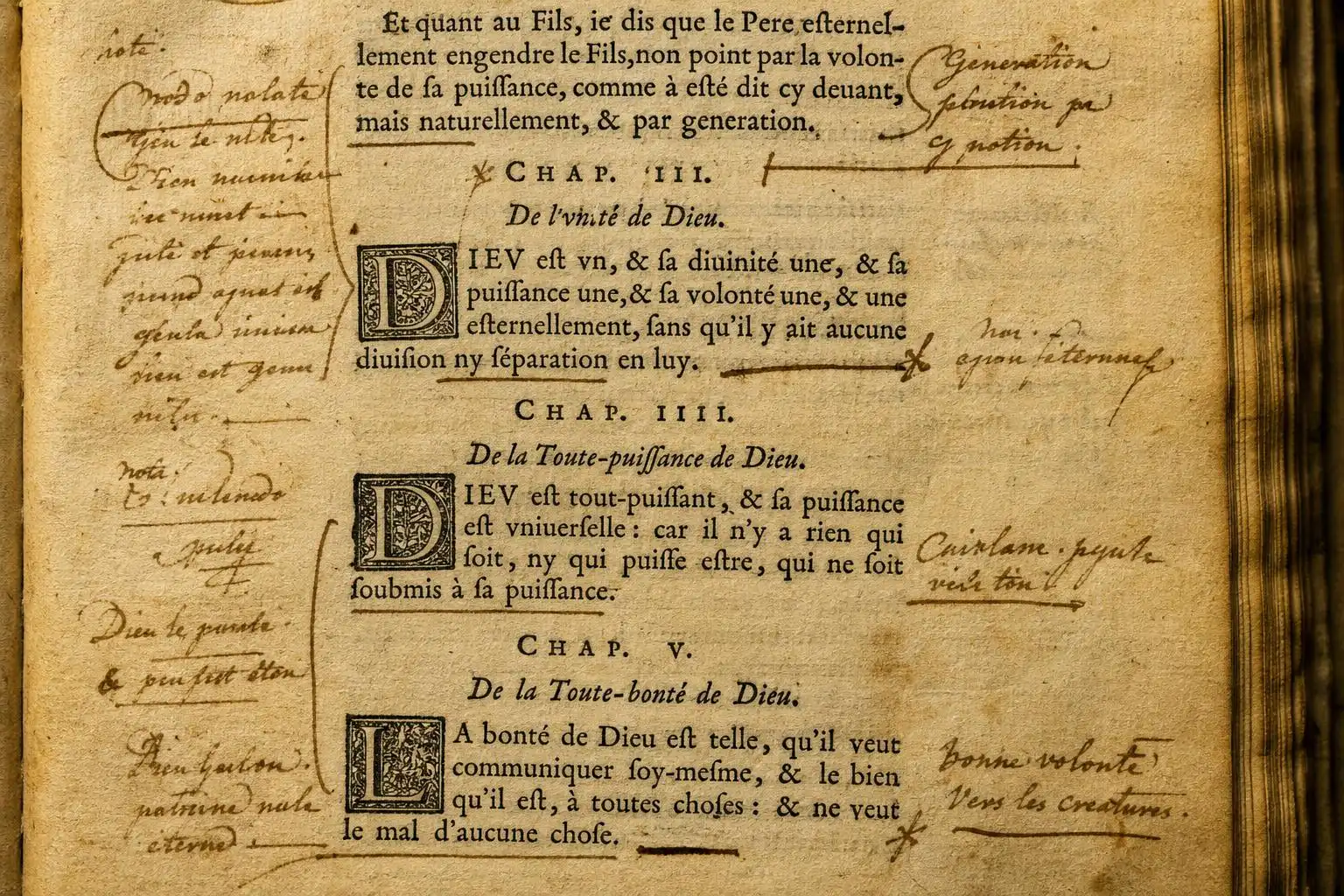

In the spring of 1580, a Bordeaux magistrate with failing memory and a stone in his kidney handed a Bordeaux printer named Simon Millanges a manuscript unlike anything the trade had seen. It had no clear genre. It was not a treatise, not a memoir, not a collection of sermons or a humanist commentary on the ancients, though it borrowed freely from all four. Michel de Montaigne called the pieces inside it essais — attempts, trials, weighings — and he insisted, with a modesty that was itself a kind of provocation, that the book was “consubstantial with its author.” Millanges printed it in two small octavo volumes. Nobody, least of all Montaigne, could have predicted that this idiosyncratic object would become one of the most reprinted, translated, plagiarized, and quietly subversive books of the early modern age.
To understand why the Essais needed a gamble at all, you have to understand what a book was in 1580: not an idea floating free, but a physical wager involving a printer’s capital, a censor’s signature, a bookseller’s shelf space, and the tolerance of magistrates who could, and did, imprison authors for less. France in 1580 was a country tearing itself apart in the Wars of Religion. The Catholic League and the Huguenot party were trading massacres. Printers who guessed wrong about which pamphlet would offend the wrong patron could lose a press, a hand, or a head. Into this climate Montaigne offered a book that mocked certainty itself, that quoted Sextus Empiricus alongside Plutarch, that admitted openly to changing its author’s mind from paragraph to paragraph — and somehow it slipped through.

A Genre With No Name
Part of what let the Essais pass unmolested was that the censors did not know what they were reading. The Sorbonne’s approbation apparatus, refined over decades of hunting Lutheran heresy in printed Latin theology, was built to catch propositions: a sentence that denied transubstantiation, a claim that faith alone justified. Montaigne wrote almost nothing that could be extracted as a proposition. His method was accretive and evasive by design — he doubled back, qualified, contradicted his earlier self in the margin of a later edition, and grounded his boldest skeptical moves in the humble genre of personal reflection. In the “Apology for Raymond Sebond,” he pressed a fideism so total it curdled into something like corrosive doubt about all human certainty, religious dogma included, likening man’s presumption to judge divine truth to the vanity of the frailest of creatures imagining itself the measure of all things. But it arrived wrapped in self-deprecation, buried in a defense of a Catalan theologian, three hundred pages long, discursive to the point of exhaustion. The book did not escape scrutiny in Rome, either: when Montaigne visited the city in 1581, papal censors examined the Essais and raised objections to particular expressions and ideas, though the work was allowed to circulate after discussion. The Roman Index would eventually catch up more formally — the Essais went on it in 1676, nearly a century after publication — but by then the book had already done its work across half of Europe.
That work depended on print in a way manuscript culture could never have allowed. A handwritten Essais might have circulated among Montaigne’s circle in Bordeaux and Paris, admired by the parlementaires who already knew him as a magistrate and by the handful of scholars who shared his taste for Plutarch in Amyot’s translation. Print turned a provincial gentleman’s private exercise into a commodity that could cross the Channel in a merchant’s trunk. By 1588, Montaigne was overseeing a much-expanded fifth edition, adding a third book and hundreds of new passages in the margins of his own copy — the famous “Bordeaux copy,” now covered in his spidery interlinear corrections, that shows a writer treating his printed text as a living thing, never finished, always subject to revision even after the ink was dry.
The Translator Who Made Him English
If the printing press gave the Essais its body, a single translator gave it an afterlife in a language Montaigne never wrote a word of. John Florio, the London-born son of an Italian Protestant exile, took on the Essais in the 1590s at the urging of aristocratic patrons who had discovered Montaigne on the Continent and wanted him in English. Florio’s 1603 translation is not a transparent window onto the French; it is its own extraordinary literary performance, thick with invented compounds and Italianate flourishes, sometimes wilder and more baroque than Montaigne’s comparatively plain Gascon prose. But it worked. The essay as a recognized English form had already arrived a few years earlier with Francis Bacon’s terse, aphoristic Essays of 1597, but Florio’s Montaigne offered English readers something Bacon did not: skepticism as a livable posture rather than a scholastic exercise, and the idea that a writer’s proper subject might simply be himself, examined without flattery. It was this personal, exploratory mode — distinct from Bacon’s — that Florio’s translation helped root in English letters.
Within a few years of Florio’s translation appearing, its language and ideas had reached a jobbing playwright in London who was, at the time, at work on plays about kings losing their grip on certainty and princes staring into moral vacuums. Whether Shakespeare owned or read a copy of Florio’s Montaigne before or while writing King Lear and The Tempest remains a matter that scholars have argued over for a century — no evidence establishes that a copy ever sat in his personal library — but the case is buoyed by verbal echoes: Gonzalo’s speech on an ideal commonwealth in The Tempest tracks Florio’s “Of the Cannibals” closely enough that coincidence strains credulity. What is not in doubt is that Montaigne’s voice, however garbled by translation, was in the London air by 1610, available to anyone who wanted a model for interrogating a self rather than simply performing one.
The Patron’s Shadow
None of this circulation happened outside the structures of patronage that governed early modern authorship. Montaigne was not a hungry professional writer dependent on sales; he was a retired magistrate and minor nobleman who had resigned and sold his post in the Bordeaux parlement specifically to have leisure for reading and writing, underwritten by inherited land and a father’s ambitions realized a generation late. That financial independence is not incidental to the book’s strange freedom. Montaigne could afford to be evasive, discursive, uncommitted to any thesis, because he did not need a patron’s favor riding on the book’s argument, the way a court propagandist or a commissioned historian did. He dedicated essays to friends and to Diane de Foix, and he moved in circles that included Henri of Navarre, the future Henri IV, whom he counseled informally during the succession crisis. But the Essais itself carried no single dedicatee whose favor the whole project depended on, no patron whose reputation it was designed to burnish. That absence of an obligated audience is part of what let Montaigne write in the first person about his kidney stones, his fear of death, his cat, and his conviction that he knew less than he used to think he did.
The book’s translators and continental admirers did not enjoy the same freedom, and their prefaces show the strain of packaging a shrugging skeptic for patrons who wanted moral instruction. Florio’s dedications to the Countess of Bedford and other noblewomen praise Montaigne’s wisdom in the confident register Elizabethan patronage demanded, smoothing over the essayist’s more radical uncertainties. Continental editors did similar work, framing the “Apology for Raymond Sebond” as pious rather than corrosive, so that the book could sit on a shelf next to devotional literature without alarming anyone who read only the frame.
What the Skeptic Left Standing
Read closely, the “Apology” is a demolition site. Montaigne marshals the ancient skeptical arsenal — Pyrrho, Sextus Empiricus, the Academic skeptics recovered and printed for a Renaissance audience only a generation or two earlier — against every claim reason makes to certain knowledge, whether about the natural world, the soul, or God. He piles up examples of human disagreement, cultural variation, animal cognition, sensory illusion, until the reader’s confidence in unaided reason lies in rubble. And then, rather than replacing that rubble with a new system, Montaigne simply stops, leaving the question of what a mind can trust dangling open, unresolved, gestured toward faith but never quite landing there with the comfort a devout reader might want.
That refusal to resolve is easy to read backward through Descartes, who inherited the skeptical machinery Montaigne had helped popularize in French and spent the Meditations trying to build a floor beneath it that would not give way. It is easy to read forward, too, into Pascal, who found in Montaigne both a kindred restlessness and an enemy he could not stop quoting. But sitting with the Essais on their own terms, in their original disorder, means sitting with an author who probed the limits of human presumption and never told you what to do about it.


Leave a Reply