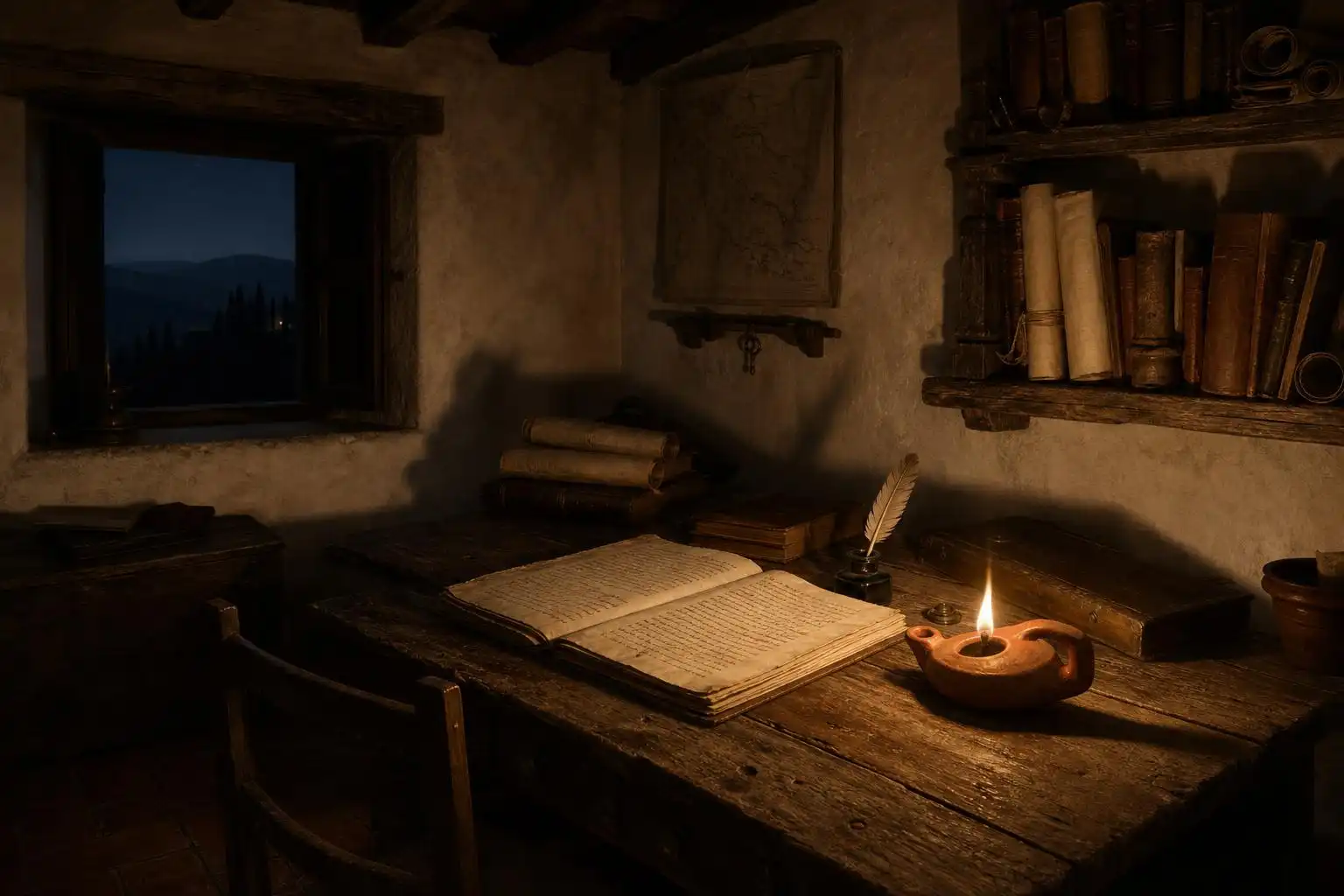

In the winter of 1513, Niccolò Machiavelli sat in a farmhouse outside Florence, recently released from prison, his fingers still bearing the marks of the strappado. He had been tortured on suspicion of conspiring against the Medici — a charge never proven — and was now back at his small estate at Sant’Andrea in Percussina, dismissed from office and politically sidelined from the city he had served for fourteen years as a diplomat and secretary of the republic. It was in this condition of enforced idleness and political humiliation that he wrote the most dangerous book of the Renaissance.
Il Principe — The Prince — was composed in a matter of months, a white heat of argument dressed in the cool language of practical counsel. Machiavelli addressed it to Lorenzo de’ Medici, the young grandson of Lorenzo the Magnificent, in a dedication so flattering it borders on self-parody. He offered his little book the way a man offers a gift he knows will be ignored. A later, dubious anecdote has Lorenzo preferring a brace of hunting dogs presented to him at the same time.
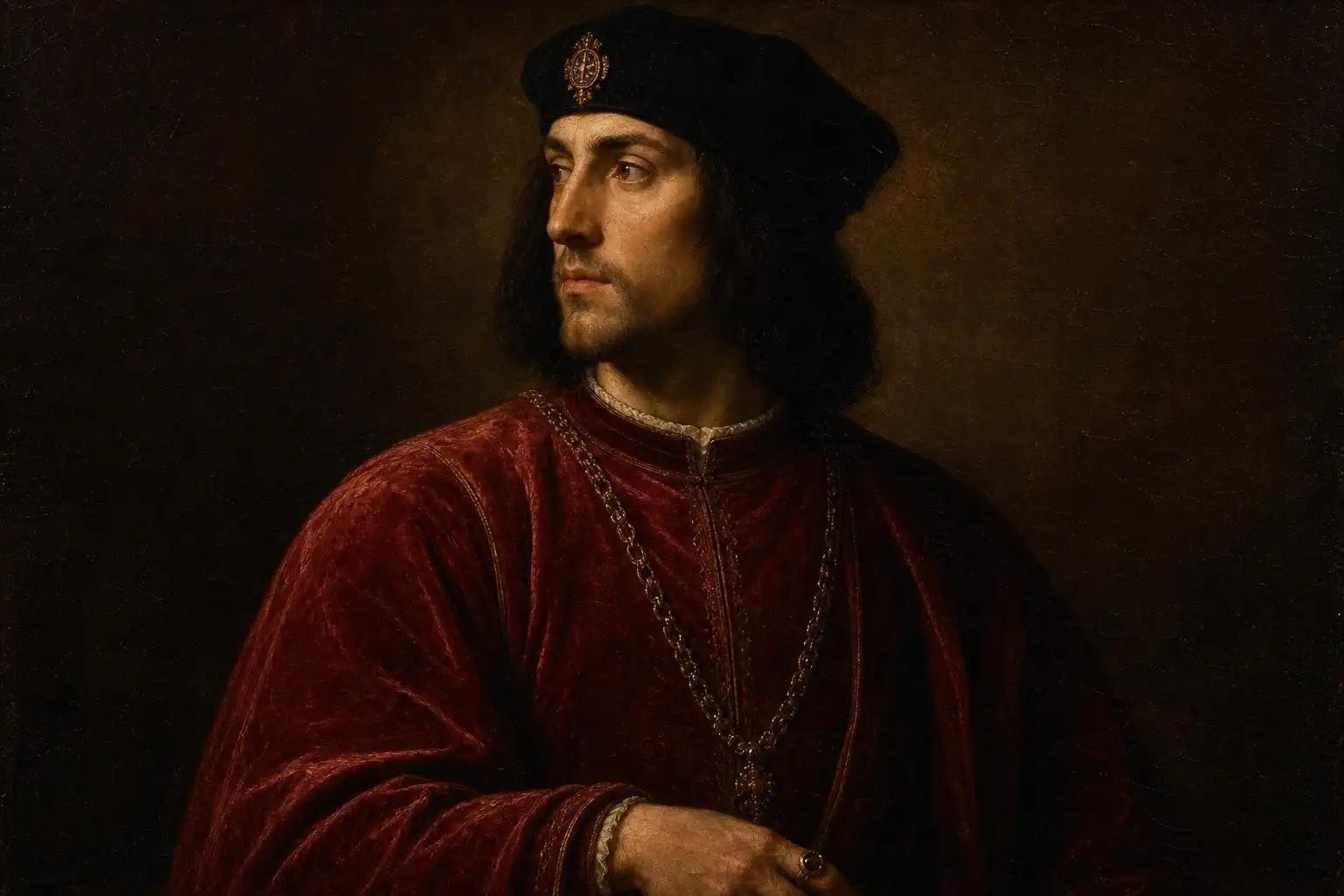
The book circulated in manuscript for years before it was printed, in 1532, five years after Machiavelli’s death. That gap matters. Manuscript culture was elite, controlled, deniable. Print was permanent, public, scandalous. When the Roman Index of Forbidden Books was established in 1559, The Prince appeared on the very first list. By then it had already escaped into the European imagination, spawning a word — Machiavellian — that its author would barely have recognized as a description of his intentions.
The Problem He Was Solving
To read The Prince as a manual of cynicism is to miss the specific crisis that produced it. Italy in the early sixteenth century was not a nation but a patchwork of city-states, duchies, and papal territories, perpetually invaded by France, Spain, and the Holy Roman Empire. Florence had swung between republic and Medici dominance for decades. Machiavelli had watched, as a working diplomat, how the great powers of Europe operated — how Louis XII of France had squandered his Italian conquests through political naivety, how Cesare Borgia had come terrifyingly close to carving out a durable principality in central Italy before fortune turned against him.
What Machiavelli was trying to solve was the problem of virtù — a word he used in a deliberately provocative way. In the humanist tradition he had inherited, virtù meant moral excellence, the classical virtues of justice, prudence, temperance, and courage. Machiavelli kept the word but stripped it of its moral content. His virtù was energy, adaptability, the capacity to impose one’s will on circumstances. It was the opposite of fortuna — the wheel of fortune, the chaos of events that no ruler could fully control. The question The Prince asks, over and over, is: how much can a man of virtù bend fortune to his purposes?
This was not a new question. What was new was Machiavelli’s refusal to answer it in the traditional way — by listing the virtues a ruler ought to possess and trusting that virtue would be rewarded. He had watched too many virtuous men fail. He had watched Piero Soderini, the gonfaloniere of Florence whom he had served loyally, driven from the city without a fight because he lacked the ruthlessness to defend himself. “It is better to be impetuous than cautious,” Machiavelli wrote, “for fortune is a woman, and it is necessary, if you want to master her, to beat and strike her.”
The violence of the image is not accidental. Machiavelli was deliberately offending the pieties of humanist political writing.
What He Actually Said — and What He Didn’t
The reputation of The Prince rests heavily on a handful of passages that have been quoted, misquoted, and decontextualized for five centuries. The most famous is the advice that it is better to be feared than loved, if one cannot be both. But Machiavelli immediately qualifies this: the prince must avoid being hated. Fear without hatred is sustainable; hatred is fatal. The prince who inspires genuine hatred — through rapacity, through touching the property or women of his subjects — will be destroyed. This is not a license for cruelty. It is a precise analysis of the political psychology of power.
Similarly, the famous chapter on the lion and the fox is often read as a simple endorsement of deception. But Machiavelli’s argument is more interesting than that. He is not saying that princes should be dishonest by nature. He is saying that a prince who keeps his word in all circumstances, regardless of whether others do, will be destroyed by those who do not. This is a claim about the structure of political life, not a moral prescription. It is the observation of a man who had spent years watching negotiations, treaties, and alliances be made and broken.
The chapter that most disturbed contemporary readers — and that most clearly shows Machiavelli’s originality — is the one on cruelty well-used. He distinguishes between cruelties that are committed all at once, for a specific political purpose, and cruelties that are prolonged and repeated. The first, he argues, can be forgiven; they serve a function and then stop. The second destroys the prince’s relationship with his subjects beyond repair. As his example, he offers Agathocles of Syracuse, a man of “savage cruelty and inhumanity” who nonetheless maintained his state for years. This is not admiration. It is analysis. Machiavelli is careful to say that Agathocles cannot be called virtuous in any meaningful sense. But he refuses to pretend that Agathocles’s methods did not work.
This is the move that made The Prince so unsettling: the refusal to let moral failure and political success cancel each other out. For the entire tradition of Christian political thought, the wicked prince was, by definition, an unstable prince. Providence would correct the imbalance. Machiavelli looked at history and saw no such correction. He saw Cesare Borgia, who did nearly everything right by his own lights, destroyed not by his wickedness but by a single piece of bad fortune — falling ill at precisely the moment his father, Pope Alexander VI, died, leaving him without the papal patronage that had sustained him.
The Book That Wasn’t Written for Us
One of the persistent errors in reading The Prince is to treat it as a timeless text — a set of principles applicable to any political situation in any era. Machiavelli did not think he was writing timeless principles. He was writing for a specific moment, a specific crisis, and a specific hoped-for reader.
The final chapter of The Prince — often dismissed as an embarrassing lapse into patriotic rhetoric — is actually the key to the whole book. It is an exhortation to whoever might read it to liberate Italy from the “barbarians,” the French and Spanish invaders who were tearing the peninsula apart. Machiavelli quotes Petrarch. He becomes, briefly, the humanist he had spent the whole book subverting. The prince he has been describing — the cold calculator of virtù, the man who uses cruelty well, who knows when to be a lion and when to be a fox — is not an end in himself. He is a means. The end is a stable, unified political community that can defend itself.
This is why the book is not simply a manual for tyrants. Machiavelli’s other major work, the Discourses on Livy, makes clear that he preferred republics to principalities as a matter of principle. Republics, he argued, are more adaptable, more resilient, better at incorporating the energy of their citizens. The Prince is not a statement of preference. It is a diagnosis of emergency — what to do when the ordinary mechanisms of political life have broken down, when a state needs to be founded or refounded from scratch.
The Scandal of the Manuscript
The life of The Prince before print is as revealing as the text itself. Machiavelli circulated it among a small circle of Florentine humanists — men like Francesco Vettori, his friend and correspondent, and Francesco Guicciardini, the great historian who would later engage critically and admiringly with Machiavelli’s political thought, especially the Discourses. These men read it as participants in a conversation, not as passive recipients of doctrine. Vettori’s letters back to Machiavelli show him pushing back, questioning, refining.
When the book finally appeared in print in 1532, published by the Blado press in Rome with a papal privilege — an irony Machiavelli would have savored — it entered a completely different world. The Reformation had fractured European Christianity. The Italian Wars had reshaped the political map. The humanist republic of letters for which the book had originally been written was dissolving into confessional and national rivalries. The Prince was now read by people who had no context for the specific Florentine crisis that had produced it, and who found in it either a terrifying endorsement of tyranny or a useful mirror for their own political anxieties.
Cardinal Reginald Pole, writing in the 1530s, claimed that The Prince had been written by the finger of Satan and that Henry VIII had used it as a guide to breaking with Rome. This was almost certainly false as a historical claim, but it was revealing as a symptom. The book had become a screen onto which readers projected their fears about the collapse of Christian political order.
Cesare Borgia’s Shadow
The figure who haunts The Prince most powerfully is Cesare Borgia, whom Machiavelli had met in person during diplomatic missions in 1502 and 1503. Borgia was then at the height of his power — the son of Pope Alexander VI, commanding papal armies, systematically conquering the Romagna region of central Italy. Machiavelli was dazzled and disturbed in equal measure. His dispatches from the Borgia court are among the most vivid pieces of political writing he ever produced.
What fascinated Machiavelli about Borgia was not his cruelty — which was real and spectacular — but his method. Borgia had pacified the Romagna by appointing a brutal governor, Remirro de Orco, to impose order, and then, when order was established, had Remirro’s body cut in two and displayed in the public square of Cesena, “with a piece of wood and a bloody knife beside it.” The population, Machiavelli notes with something approaching admiration, was simultaneously “satisfied and stupefied.” The violence had been real. The spectacle of justice — the punishment of the man who had committed the violence — was theater. But the theater worked.
This is Machiavelli at his most unsettling: not endorsing the murder of Remirro de Orco, but noting, with the precision of a naturalist, that it achieved its intended effect. The question he leaves hanging is whether a political order built on such foundations can be stable — and whether stability, achieved by such means, is worth having.
He never quite answers it. In Chapter Seven, after laying out Borgia’s methods in admiring detail, he notes that Borgia’s entire project collapsed because of a single piece of bad fortune — the death of his father at the wrong moment. “If all his measures were not sufficient,” Machiavelli writes, “it was not his fault, because this arose from an extraordinary and extreme malignity of fortune.” The man who had done everything right was destroyed anyway. The lesson is not that virtù guarantees success. It is that virtù is the only bet worth making, because the alternative — passivity, reliance on fortune, trust in the goodness of others — is even more certain to fail.
The Unwritten Dedication
The dedication to Lorenzo de’ Medici is a document of pure desperation, and reading it knowing what we know about Machiavelli’s situation makes it almost unbearable. He was forty-four years old, his career destroyed, his body damaged by torture, watching from the countryside as younger men occupied the offices he had held. The book he was offering was the best thing he had ever made. The man he was offering it to was a young Medici heir who, in the later anecdote, preferred dogs.
Machiavelli knew, at some level, that this was the situation. His letters to Vettori from this period are full of black comedy — descriptions of his days spent playing cards with the local innkeeper and peasants, arguing about a farthing, then retreating in the evenings to his study, where he put on his “regal and courtly garments” and entered, through his books, the courts of ancient men. “There I am not ashamed to speak with them,” he wrote, “and to ask them the reason for their actions; and they in their kindness answer me.”
The Prince was written in those evenings, in conversation with the ancient dead, by a man who had been shut out of the living political world. It is, among other things, a book about what it means to understand power without being able to exercise it — to see clearly what rulers do and why, and to be unable to change any of it. The imaginary prince to whom the book is addressed never came. The real Lorenzo ignored it. Italy was not liberated from the barbarians. Machiavelli died in 1527, the same year that Spanish and German troops sacked Rome, an event so catastrophic it seemed to confirm everything he had written about the weakness of Italian political life.
The question that The Prince leaves open — whether a sufficiently clear-eyed understanding of political reality can ever translate into political action, or whether the gap between knowing and doing is itself a kind of permanent condition — is one the book poses without resolving. Chapter Twenty-Five, on fortune, ends with the famous image of fortune as a river that can be controlled by dykes and embankments built in advance. But Machiavelli adds, almost in passing, that men cannot change their natures — that the man who succeeds by caution will not become impetuous when caution fails him, and the man who succeeds by impetuosity will not learn to be cautious when the times change. The dykes must be built before the flood. And most men build nothing until the water is already rising.



Leave a Reply