
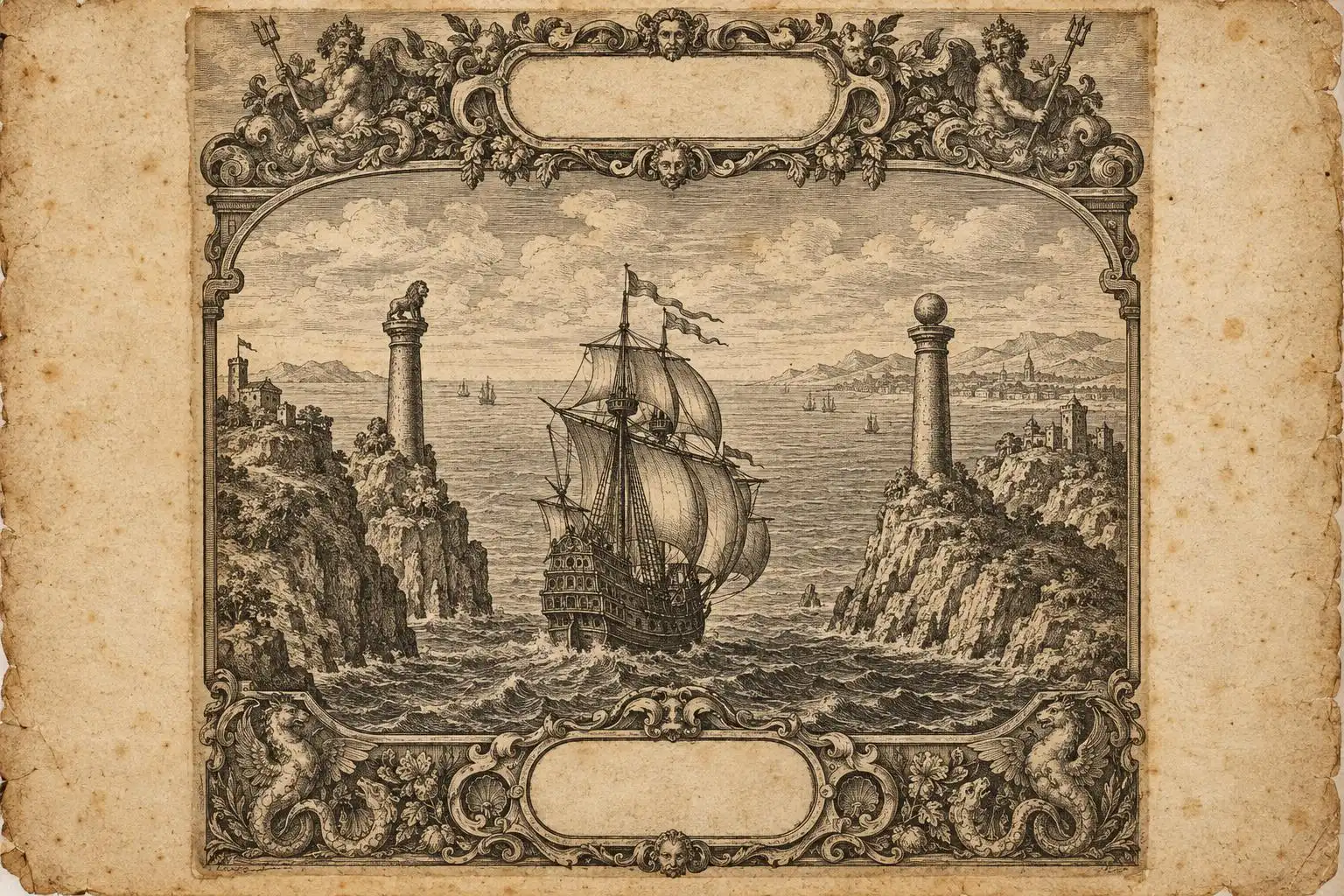

On the engraved title page of Francis Bacon’s Great Instauration, a ship sails beyond the Pillars of Hercules. The image promised a voyage past the limits of inherited knowledge. Inside the book, published in London in 1620, Bacon warned that the hardest obstacle was not an ocean or an ancient authority. It was the mind aboard the ship.
The Novum Organum, the second part of Bacon’s projected work, offered a method for investigating nature. Before readers could use it, however, they had to confront what Bacon called the “idols”: patterns of error that make a plausible thought feel like a discovery. He named four kinds, each with its own hiding place.

The idols of the tribe
The first belong to the human “tribe.” We look for order, Bacon argued, even where the evidence is uneven. Once we favor an explanation, confirming cases catch our eye more readily than contrary ones. Our senses compound the trouble: they report the world from a human vantage point, not from nowhere.
Bacon’s warning was not that observation is useless. It was that an observation does not arrive already interpreted. A person who notices several successful predictions may stop counting the failures. The remedy begins by asking which cases an attractive theory leaves out.
The idols of the cave
Each person also inhabits a private cave, shaped by education, temperament, reading, and habit. One investigator favors similarities; another is drawn to differences. Years spent mastering a particular subject can make its methods seem suitable for every question.
Bacon wrote from a world in which learning depended heavily on patrons, universities, and access to books. Those institutions could sustain inquiry, but they could also determine which questions seemed worth asking. His cave was not merely a matter of personal prejudice: a thinker’s intellectual surroundings helped furnish it.
The idols of the marketplace
The marketplace was where people met and spoke—and where words could quietly mislead them. Names gathered unlike things under one label, or gave apparent substance to something poorly understood. An argument could then turn on a word while seeming to concern nature.
This was a sharp problem for a project that needed knowledge to circulate. Printers could multiply a claim; correspondents could repeat it across Europe. Neither process guaranteed that its terms meant the same thing to everyone. Bacon wanted investigators to attend to particulars rather than let familiar language settle a question in advance.
The idols of the theatre
The final idols came from elaborate systems of thought. Bacon compared them to plays: coherent worlds constructed on a stage, persuasive while the performance lasts. His chief target was the habit of treating an established philosophy as a complete account of nature, then fitting observations into its plot.
He was not asking readers to burn their books. He was asking them to distinguish an author’s authority from a tested account of the world. That distinction mattered in a culture where ancient texts remained central to advanced education. The most elegant explanation could still fail before a stubborn contrary case.
What comes after suspicion
Identifying idols was only the beginning. In the Novum Organum, Bacon proposed assembling organized records of instances in which a phenomenon appears, fails to appear, or varies in degree. Heat supplied one of his examples. Rather than announce its cause after inspecting a flame, an investigator should compare many kinds of warmth and look closely at cases that challenge the first explanation.
This was an immense demand. It called for observations and experiments gathered over time, often with resources no solitary philosopher possessed. Bacon sought royal support for the larger project and imagined inquiry as coordinated labor. The book itself, with its ambitious title page and carefully printed argument, was part of that effort to recruit others. He never completed the six-part Great Instauration.
Bacon’s proposed method did not become a universal recipe for science. But its opening diagnosis remains unusually vivid. The ship on the title page has cleared the old boundary; below deck, its passengers still carry their caves, their words, their favored stories. Bacon’s question was how they might recognize one of those companions before mistaking it for the coast ahead.



Leave a Reply
You must be logged in to post a comment.