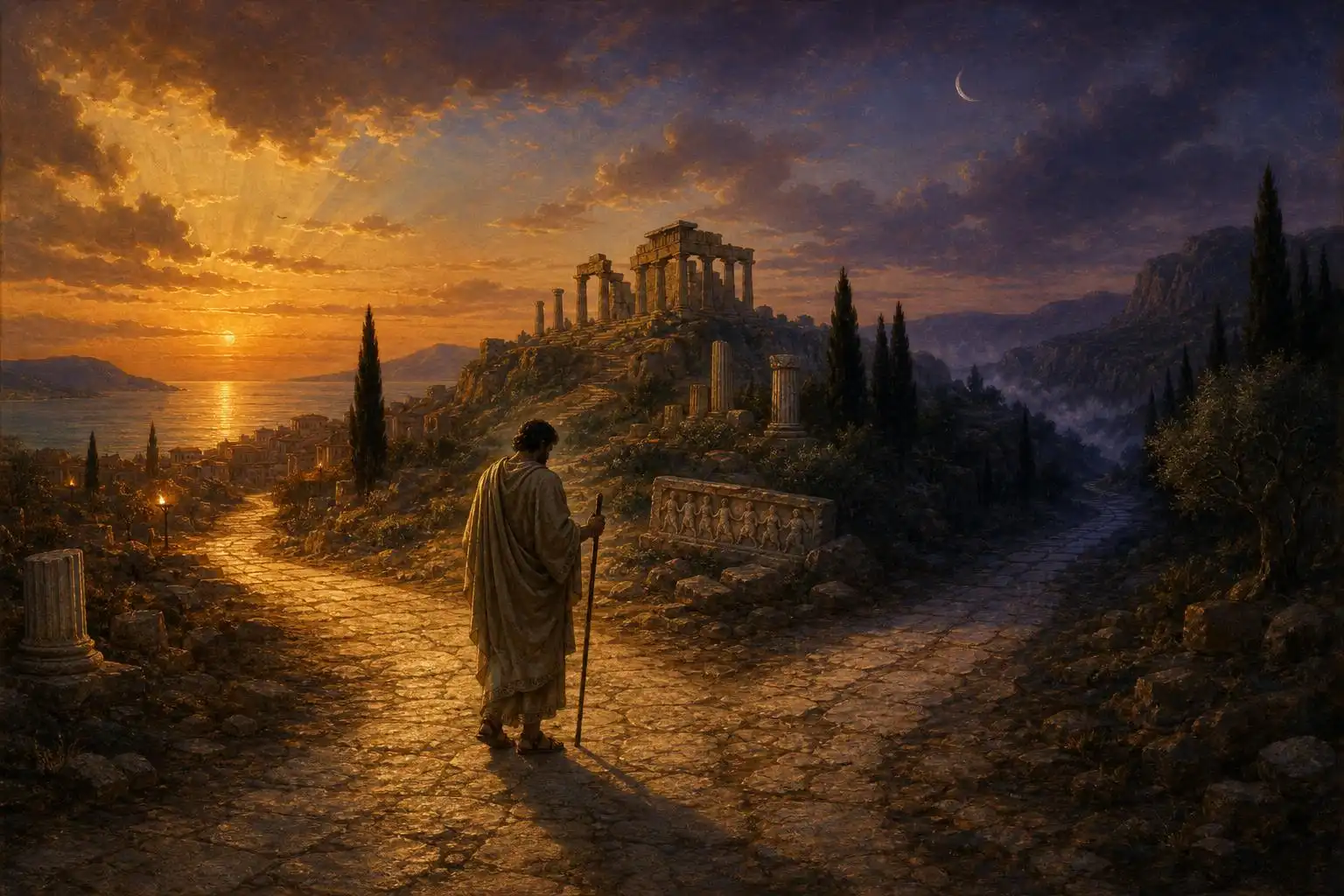

Somewhere in southern Italy, around 480 BCE, a philosopher from Elea composed a poem. We have roughly 150–160 lines of it. The rest is gone — absorbed into the silence that seems, with a kind of dark irony, to suit its subject perfectly. What survives is enough to make Parmenides the most disorienting thinker of the ancient world, a man whose argument is so clean and so ruthless that it still has not been fully answered.
The poem is called On Nature by convention, though Parmenides probably gave it no title. It begins with an extraordinary scene: the poet is carried in a chariot drawn by mares along a road to the gates of Night and Day, where a goddess — unnamed, serene, absolute — receives him and promises to reveal two things. First, the heart of well-rounded Truth. Second, the opinions of mortals, in which there is no true trust. This is not decoration. The frame of the poem is doing philosophical work. Parmenides is claiming that what follows is not his opinion. It is what is, disclosed by a power that stands outside the fumbling world of human perception.
The Goddess’s Argument
The argument the goddess delivers is, at its core, a single thought pressed to its logical extreme. It goes roughly like this:
Either something is, or it is not. If it is not, then it cannot be spoken of, thought about, or in any way encountered — for to think of something is already to think of something, and that something must be. Therefore, the path of “is not” is utterly impassable. We cannot even coherently set foot on it. What remains is the path of “is” — and this path, followed to its end, yields a being that is ungenerated, imperishable, whole, single, motionless, and complete.
The Greek is stark. Fragment 2 gives us the fork in the road:
ἡ μὲν ὅπως ἔστιν τε καὶ ὡς οὐκ ἔστι μὴ εἶναι — the one, that it is and that it is not possible for it not to be…
ἡ δ᾽ ὡς οὐκ ἔστιν τε καὶ ὡς χρεών ἐστι μὴ εἶναι — the other, that it is not and that it must not be.
The second path is immediately closed off. You cannot say or think what is not, because saying and thinking require an object, and an object must be. This is the earliest surviving formulation of what we might call the reference problem — the puzzle of how language can reach out and touch nothing at all.
What Follows from “Is”
If you grant the first step, the rest follows with a kind of merciless elegance. Being cannot have come into existence, because before it existed there would have been nothing — and nothing cannot give rise to something. It cannot pass away, for the same reason in reverse. It cannot be more here and less there, for that would mean some part of it “is less,” which slides back toward not-being. It has no past and no future, only an eternal present: νῦν, now, always now.
Fragment 8 is where this unfolds in detail, and it is worth sitting with the image Parmenides reaches for at the end of his description of Being: he compares it to a well-rounded sphere (εὐκύκλου σφαίρης), equal in all directions from the center. This is not a physical sphere. It is a metaphor for the completeness and uniformity of what truly is — no edges, no gaps, no variation, no story to tell about it, because stories require change and change requires that something become what it was not.
The implication is devastating. Everything we experience — motion, plurality, color, birth, death, the passage of time — belongs to the second part of the poem, the “Way of Opinion.” Mortals wander along that path, two-headed, unable to distinguish being from not-being, naming things as though the names carved reality at its joints. They do not. The world of appearances is not straightforwardly false, but it is not the Truth the goddess has just delivered.
The Problem of the Second Part
Here the poem becomes genuinely puzzling, and scholars have never stopped arguing about it. If the Way of Opinion is not to be trusted, why does Parmenides spend so much of the poem elaborating it? The surviving fragments include a cosmology — fire and night, a goddess who steers everything, an account of perception and generation. It looks, from the outside, like a rival to Milesian physics. Why offer it at all?
One answer, associated with scholars like Alexander Mourelatos, is that the cosmology is a best possible account of the phenomenal world — not true, but the most coherent story you can tell if you insist on talking about the world of appearances. Parmenides is not endorsing it; he is modeling it, the way a mathematician might construct a proof by contradiction, showing you what follows if you make the wrong assumption.
Another answer, more unsettling, is that we simply do not have enough of the poem to know. Roughly 150–160 lines out of what may have been eight hundred. The goddess may have said more about the relationship between Truth and Opinion than we can recover. The break between the two sections of the poem, in the text as we have it, is abrupt. We are reading ruins.
Zeno and the Defense
Parmenides was not arguing alone. His student Zeno of Elea produced a series of arguments — the famous paradoxes of motion — designed to show that the commonsense world of plurality and movement generates logical contradictions. If there are many things, they must be both infinitely large and infinitely small. If an arrow moves, it must at each instant be at rest. These arguments were not meant to be clever puzzles. They were a defense of the master’s position: if you try to take the Way of Opinion seriously, you end up in absurdity.
Aristotle, who had no patience for Parmenides’ conclusion but enormous respect for his method, called Zeno the inventor of dialectic. That is a striking tribute. Whatever you think of the paradoxes — and Aristotle thought he had refuted them, though philosophers of mathematics are less sure — they represent the first sustained attempt in Western thought to use rigorous argument to demolish an opponent’s position rather than simply assert a different one.
The Goddess’s Challenge
What Parmenides leaves us with, in the end, is not a system but a demand. The demand is that thinking be consistent with itself — that if you say something exists, you must be willing to follow out what that entails, and if the entailments are monstrous, you must either accept them or give up the starting point. He was the first philosopher to take that demand seriously enough to let it overturn everything.
Plato spent much of his career wrestling with the consequences. The dialogue he named Parmenides stages a confrontation between the old Eleatic and the young Socrates, and it is one of the most technically demanding texts in the corpus. At its center is the question Parmenides himself raised: if there is only one Being, how do we account for the many things we seem to encounter? Plato’s answer — the theory of Forms — is in some sense an attempt to give Parmenides what he wants (eternal, unchanging, fully real objects) while also saving the appearances. Whether it succeeds is a question the dialogue itself seems designed to leave open.
Near the end of the Parmenides, after a dizzying series of hypotheses about the One and the Many, the dialogue reaches a conclusion so compressed it reads almost like a joke: “Let this much be said: that, it seems, whether the one is or is not, both the one and the others, in relation to themselves and to each other, all in every way are and are not, and appear and do not appear.” Plato is not being evasive. He is showing his reader that the problem Parmenides posed has not been dissolved — it has been refined, made more precise, and handed back unsolved.
That is where Plato’s dialogue leaves us. Not with an answer, but with the shape of the question made newly visible.


Leave a Reply