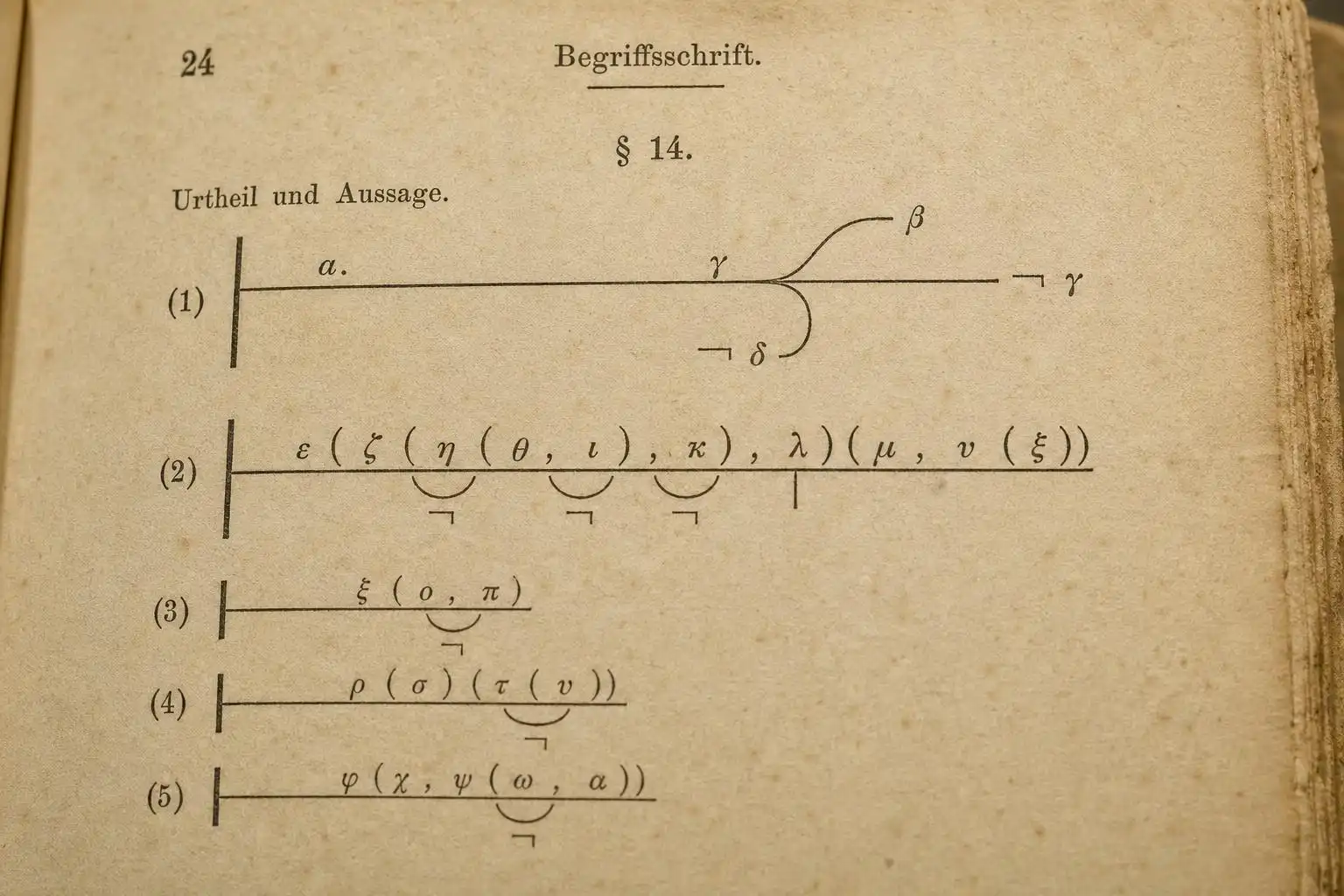

In 1879, a German mathematician named Gottlob Frege published a slim, strange pamphlet that almost nobody read. Its title translates roughly as Concept-Script: A Formal Language of Pure Thought Modelled on that of Arithmetic. Its notation was unfamiliar, its ambitions were vast, and its immediate reception was close to silence. Bertrand Russell would later call it one of the most important works in the history of logic. He was not wrong — but the importance ran deeper than logic alone. The Begriffsschrift did not merely improve on Aristotle’s syllogistic. It changed what philosophers thought they were doing when they tried to say something true.
The Problem Frege Was Solving
To understand what Frege achieved, you have to feel the weight of the problem he was solving. Mathematics, by the late nineteenth century, had grown uncomfortable with its own foundations. Analysis — the rigorous study of limits, continuity, and the infinite — had been placed on firmer ground by Cauchy and Weierstrass, who replaced intuitive appeals to motion and flow with precise epsilon-delta definitions. But the firmer you made the ground, the more you noticed what was underneath it. What, exactly, was a number? What made an arithmetical truth necessary — true not just as a matter of fact, but in a way that could not have been otherwise?
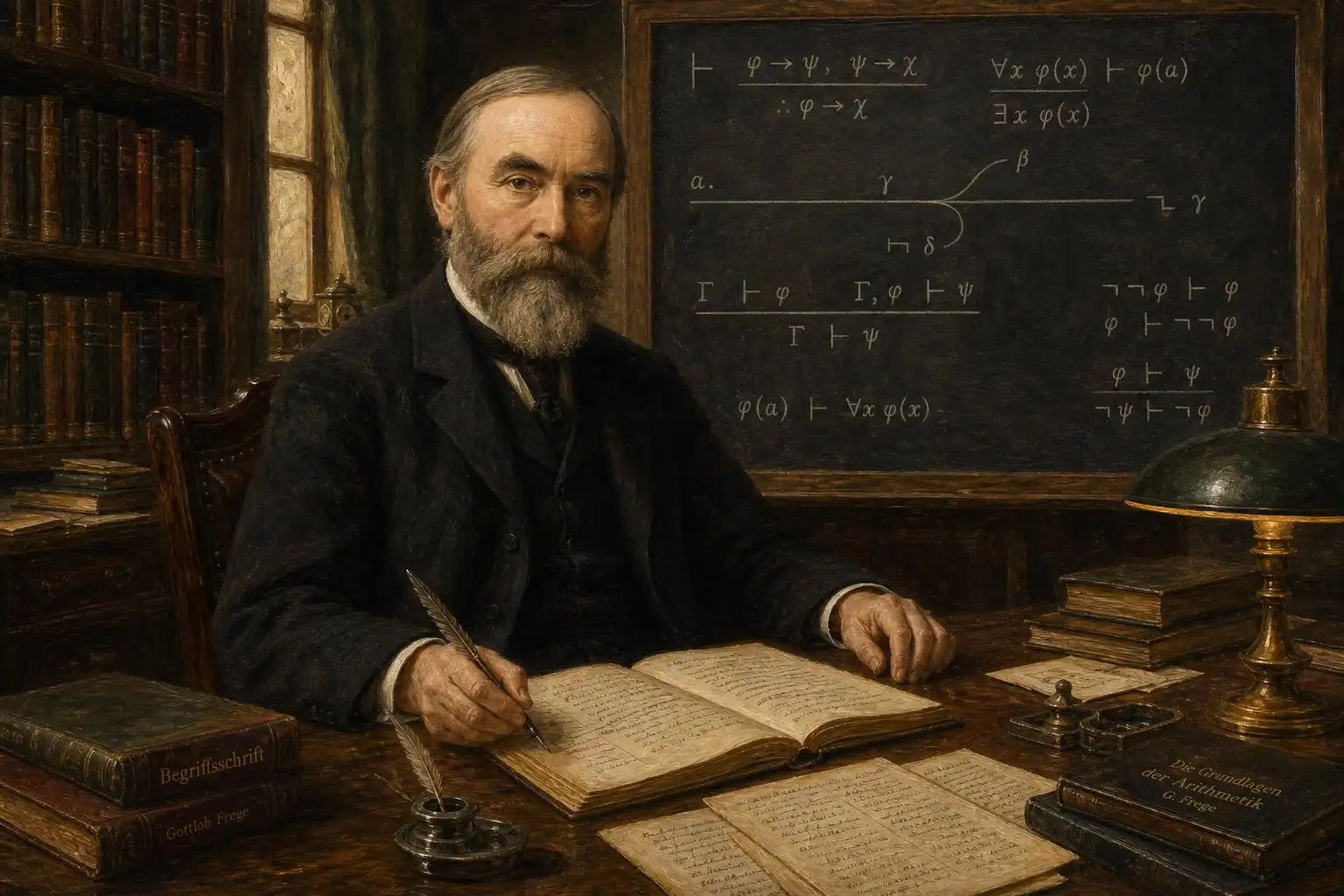
Frege’s answer was that arithmetic was a branch of logic. Numbers were not objects in the physical world, not marks on paper, and not mental images in anyone’s head. They were logical objects, definable from purely logical concepts without remainder. This thesis — logicism — required, as a precondition, that logic itself be made rigorous enough to carry the weight. The syllogistic inherited from Aristotle, which sorted arguments into a handful of valid forms involving subjects and predicates, was nowhere near sufficient. Frege needed a new logic, and he built one.
What the New Logic Did
The core innovation of the Begriffsschrift is the distinction between function and argument. Traditional logic analyzed the sentence “Socrates is mortal” as a subject (“Socrates”) combined with a predicate (“is mortal”). This works tolerably well for simple sentences. It breaks down almost immediately when sentences involve relations, multiple generality, or nested quantification.
Consider the sentence: “Every natural number has a successor.” Traditional logic has no clean way to represent this. The subject seems to be “every natural number,” but “every natural number” is not a thing in the world — it is a way of ranging over all things of a certain kind. Frege’s move was to analyze such expressions in terms of functions and arguments rather than as labels attached to subjects. In his later semantics, this became the view that concepts are functions from objects to truth-values: feed it Socrates, and you get truth; feed it the number seven, and you get falsehood. In the 1879 system, the crucial point was already that quantifiers — “all,” “some,” “there exists” — could be represented by binding variables and applying explicit formal rules.
This is the apparatus that makes modern predicate logic possible. With it, you can represent “Every natural number has a successor” without distortion: for all x, if x is a natural number, then there exists a y such that y is the successor of x. The logical structure is now fully visible, and it can be manipulated by explicit rules. The sentence where the problem turned is not dramatic — it looks like a piece of technical notation — but its consequences were enormous.
From Logic to Philosophy
Frege’s technical achievement would have mattered to mathematicians and logicians regardless of what happened next. What made it the seed of a philosophical tradition was the use to which Russell, Wittgenstein, and the Vienna Circle put it.
Russell saw in Frege’s logic a tool for dissolving philosophical puzzles that had seemed intractable. His theory of descriptions, published in 1905 in “On Denoting,” is the clearest early example. The sentence “The present King of France is bald” had puzzled philosophers because it seems to be about something — the present King of France — that does not exist. How can a sentence be meaningful if its subject refers to nothing? Russell’s answer, made possible by Frege’s logical framework, was that the grammatical subject is not the logical subject. Analyzed properly, the sentence says: there is exactly one thing that is presently King of France, and that thing is bald. This is not a sentence about a non-existent king; it is a false existential claim. The puzzle dissolves once you see through the surface grammar to the logical form underneath.
This move — dissolving a philosophical problem by revealing its hidden logical structure — became the signature gesture of analytic philosophy. It carried with it a particular picture of what philosophy was for: not the construction of grand metaphysical systems, but the careful analysis of language and thought, the exposure of confusions that arise when words outrun their legitimate use.
The Narrowing
It would be dishonest to tell only the success story. The same tools that clarified some problems obscured others, and the analytic tradition’s confidence in its method sometimes hardened into a refusal to take seriously questions the method could not reach.
The logical positivists of the Vienna Circle drew the sharpest line. In the broader empiricist program of logical positivism, the new logic associated with Frege and Russell supplied important formal tools, but the criterion of meaningfulness was the Circle’s own verificationist thesis: a sentence was cognitively significant only if it was either analytically true (true by logic and definition alone) or empirically verifiable. Everything else — metaphysics, ethics, theology — was not false but meaningless, a kind of sophisticated noise. This was a remarkable claim, and it was stated with remarkable confidence. It was also, as became clear over the following decades, self-undermining. The verification criterion is itself neither analytically true nor empirically verifiable. It cannot pass its own test.
Quine’s “Two Dogmas of Empiricism,” published in 1951, pressed further. The very distinction between analytic and synthetic truths — the distinction between truths of logic and truths of fact that the positivists had inherited from Frege and Kant — could not, Quine argued, be made precise. There was no clean boundary between what a sentence meant and what the world was like. The edifice that had been built on Frege’s foundations began to look less like a completed structure and more like a research program, still open, still contested.
What Remains
None of this undoes what Frege did. Predicate logic, with its quantifiers and variables and explicit inference rules, remains the lingua franca of formal philosophy, mathematics, and computer science. The insistence on clarity — on saying precisely what you mean and being prepared to show your inferential work — remains the animating norm of analytic philosophy at its best.
But the history is a useful corrective to any picture of philosophy as a discipline that simply accumulates progress. Frege’s logic was a genuine advance. The philosophical program built on it was a genuine achievement. And the overreach — the attempt to reduce all meaningful thought to what the new logic could certify — was a genuine failure, visible in retrospect even if not always admitted at the time.
The lesson is not that technical tools are useless in philosophy. It is that no tool, however powerful, determines in advance what it can be used for. Frege invented the instrument. What the analytic tradition did with it — the insights it generated, the questions it foreclosed, the confusions it introduced while dissolving others — is a story that is still being written.



Leave a Reply