


Suppose you woke tomorrow in someone else’s body, with your memories, ambitions, and sense of having lived your life. Would you still be you? John Locke’s answer begins by asking what the word person is meant to track. The continued existence of a body is one question; the continued existence of a person is another.
In Book II, chapter 27 of An Essay Concerning Human Understanding, Locke argues that personal identity reaches as far back as consciousness can reach. It is a striking proposal, but it is easy to make it sound simpler than it is. He is not merely saying that memories matter. He is trying to explain why a past action counts as mine.
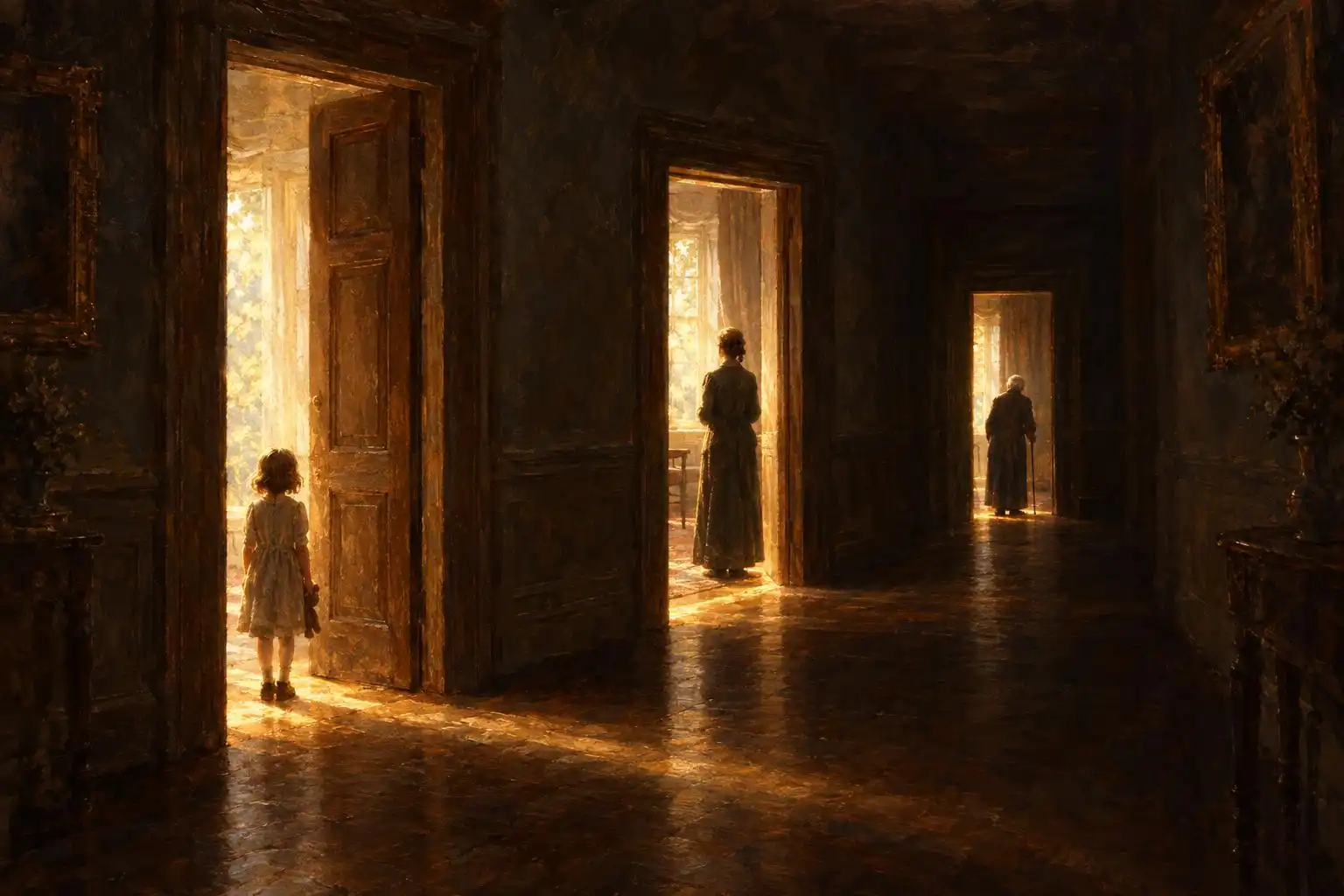
A Person Is Not Simply a Human Organism
Locke distinguishes a person from a human being. A human organism persists through biological change: the child grows, loses cells, and becomes an adult. We can still call it the same human being because one living body has continued through that process. But Locke thinks this does not yet settle whether the child and adult are the same person.
Nor, he argues, can we settle the matter by saying they have the same immaterial soul. Even if souls exist, we cannot observe which soul is present in another person—or establish that the very same soul has accompanied every episode of a life. More importantly, an unchanged soul would not by itself explain why I should regard an experience of which I have no consciousness as something I underwent.
For Locke, a person is a thinking being that can consider itself as itself at different times. Consciousness makes this possible. When I remember writing a letter yesterday, I do not merely picture someone writing it; I recognise the action as my own. That recognition is central to what Locke means by being the same person across time.
Why the Prince and the Cobbler Matter
Locke tests the distinction with an imagined exchange. Suppose a prince’s consciousness, carrying the prince’s memories, enters the body of a cobbler, while the cobbler’s consciousness departs. The resulting individual has the cobbler’s body but recalls the prince’s life from the inside. Who is he?
Locke says he would be the same person as the prince, though not the same human being. The example is not offered as a prediction about what could happen in a workshop. It isolates two proposed grounds of identity—bodily continuity and conscious continuity—by pulling them apart. If we think the prince should answer for the prince’s earlier deeds, we have reason to think personal identity follows consciousness rather than the body.
That last point matters. Locke calls “person” a forensic term: one concerned with the attribution of actions and responsibility. Asking who I am is not only asking what persists in nature. It is also asking which deeds I can own, and for which deeds it is fair to hold me accountable.
How Far Back Does Consciousness Reach?
Locke’s formulation has a demanding edge. The same person exists across two times, he says, insofar as present consciousness can extend back to a past thought or action. If I can now be conscious of having performed an action, that action belongs to me as a person.
What, then, of a forgotten childhood? Locke’s account appears to deny that a present person is identical, as a person, with a past self whose experiences are wholly beyond the reach of present consciousness. This does not mean the child’s body vanished or that childhood ceased to happen. It means biological history alone cannot establish the personal identity Locke is trying to explain.
Ordinary law often treats people as responsible for actions they do not remember. Locke recognises the difficulty, including the case of someone who was drunk and later cannot recall what they did. A court cannot reliably determine whether consciousness was present or absent at the time, so it must use the evidence available. Locke’s proposed standard for perfectly just attribution may therefore differ from the procedures a human court can follow.
Reid’s Brave Officer Objection
Thomas Reid later pressed a problem in the reach-back test. Imagine a boy punished for stealing fruit. Years later, as a young officer, he remembers that punishment. Still later, as a general, he remembers a courageous act from his days as an officer but has entirely forgotten the punishment.
On Locke’s apparent test, the officer is the same person as the boy, and the general is the same person as the officer. Yet the general cannot extend his consciousness back to the boy’s punishment. The test seems to say that the general is not the same person as the boy. That conflicts with a basic feature of identity: if A is identical to B, and B to C, then A is identical to C.
Reid’s objection is not simply that people forget. It identifies a structural problem. Direct conscious access can disappear between stages of a life, whereas identity cannot cease to hold between two stages while continuing to hold through an intermediate one. A later account might appeal to chains of overlapping memories or other psychological connections, but that would be a revision of the straightforward reach-back test, not an answer supplied by it.
What Locke’s Argument Leaves Us
Locke has not proved that a life consists only of what its owner can recall. His distinction instead forces a question that bodily continuity alone cannot answer: why does a past experience belong to this subject? The prince-and-cobbler case gives consciousness a powerful claim, while Reid’s case shows how difficult it is to turn that claim into an exact rule of identity.
That is why Locke’s argument remains useful. It asks us to distinguish a living organism, a thinking subject, and someone to whom an action can be attributed—roles we often combine under the single word “I.” Once separated, they do not fit back together quite so easily.



Leave a Reply
You must be logged in to post a comment.