


A photograph shows you at eight years old. You probably look different, want different things, and remember only fragments of the day it was taken. Yet you say the child is you. What, exactly, stayed the same? The answer matters when we keep promises, assign responsibility, or hope to survive into old age.
The River and the Soul
Heraclitus, writing in ancient Greece, pictured a river whose waters are always changing. We can still call it the same river. Perhaps a person, too, persists through change without retaining the same material throughout. But a river’s name serves our purposes; it does not settle what makes one person, rather than another, the subject of a life.
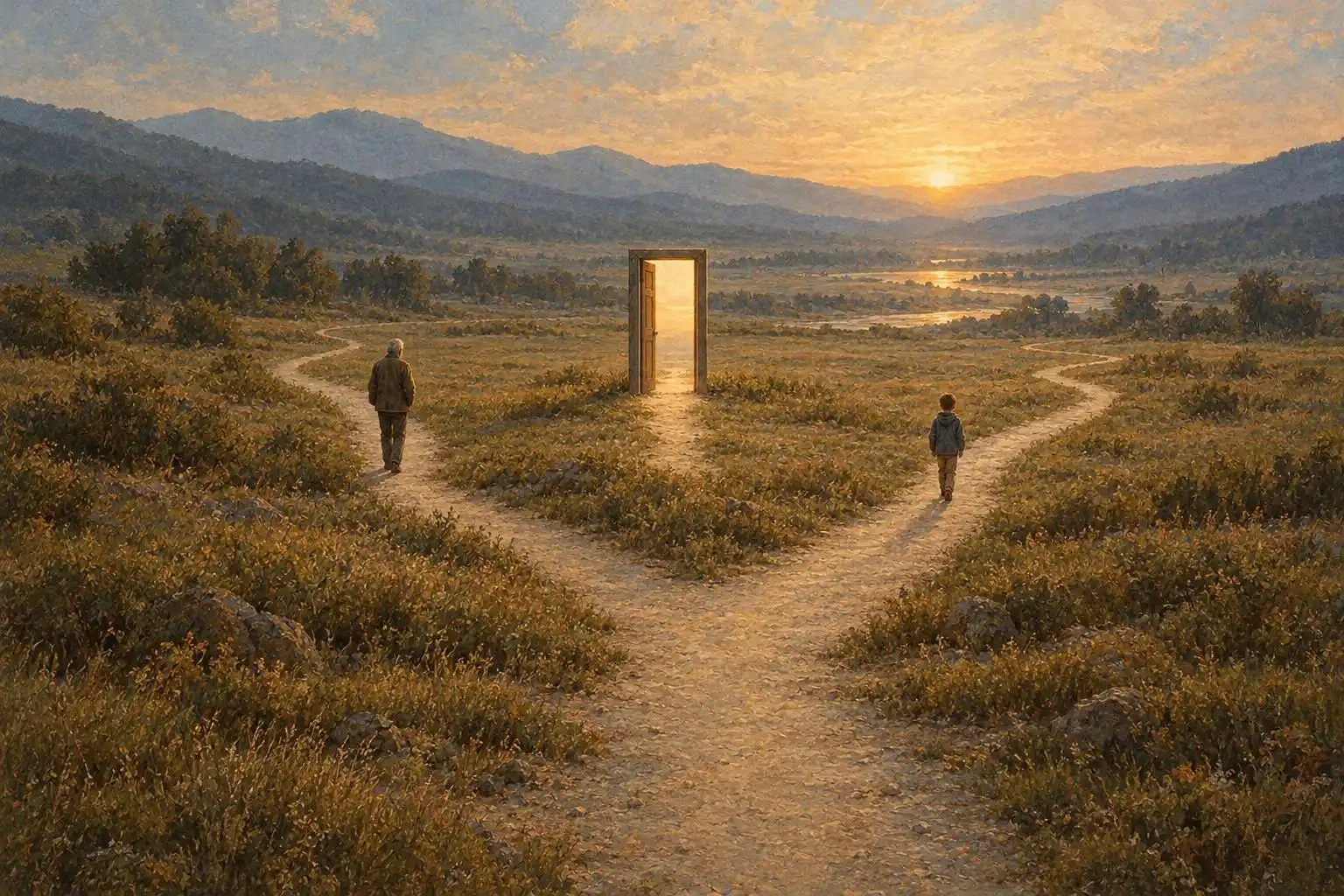
Plato offered a more enduring candidate: the soul. In the Phaedo, Socrates argues that the soul is not simply the body and considers whether it survives death. If a soul remains while the body changes, personal survival begins to look possible. Yet this answer creates another question. How would we tell whether the same soul was present if someone’s character, memories, and body were all different?
Medieval philosophers developed their own accounts of the soul and resurrection; the early modern debate returned to the question of what makes someone recognizably the same person over time.
Locke’s Remembering Self
John Locke drew a distinction between being the same human organism and being the same person. Imagine, he suggested, that a prince’s consciousness arrived in a cobbler’s body, complete with the prince’s memories. Whom would that person take himself to be? Locke’s answer points toward the prince, even though everyone else would see the cobbler’s body.
For Locke, personal identity reaches as far back as consciousness can extend to a past action. Memory matters because it lets me regard a past experience as mine. This also bears on responsibility: if I genuinely remember making a promise, I can understand why it binds me now. Locke called “person” a forensic term—a word concerned with actions and their attribution.
But memory is an awkward foundation. Most of us cannot remember being two years old. We would not ordinarily conclude that the toddler was a different person. Forgetting may break access to a past experience without breaking the life that connects us to it.
When Memory Breaks
David Hume pressed a deeper worry. Looking inward, he said, he found particular experiences—sensations, emotions, thoughts—but never an additional impression of a lasting self that owned them. On this view, the self may be less like a hidden object than a collection of changing experiences linked by habit and imagination.
Hume’s challenge does not make your memories or relationships unreal. It asks whether those connections require a further, unchanging owner. If we never encounter such an owner, perhaps continuity is something a life has, not evidence of a separate thing carried through it.
Thomas Reid then exposed a problem in Locke’s memory account. Suppose an old general remembers winning a battle as a young officer, and the young officer remembered stealing fruit as a child. The general has forgotten the theft. If identity depends on direct memory, the general is the officer and the officer is the child, but the general is not the child. That cannot be right: if A is B and B is C, A must be C.
A defender of memory can answer by appealing to chains of overlapping memories rather than one unbroken recollection. But another difficulty remains. To remember my childhood, must I already know that it was mine? If so, memory might help us discover identity without being what creates it.
Is Survival More Important Than Identity?
In the twentieth century, Derek Parfit asked us to imagine a machine that destroys your body while producing a person elsewhere with your memories, character, and plans. Would you survive? Now imagine it produces two such people. Each has the same claim to your past, but they cannot both be numerically identical to you: if both were you, they would be identical to each other. They are not.
Parfit drew a striking possibility from cases like this. Perhaps what matters in survival is not a further fact about being one and the same person. Perhaps it is psychological continuity: the preservation, in the right causal way, of memories, intentions, and character. Two successors might each inherit much that matters to you, even where the question “Which one is really me?” has no satisfactory answer.
That proposal need not persuade us that bodies are irrelevant. Actual people do not pass through copying machines, and our memories and plans depend on living brains. Parfit’s imagined cases test whether bodily persistence is the reason we care about the future, or whether it matters partly because it normally carries our experiences and relationships forward.
A Life Without a Single Test
Across these arguments, the question changes shape. Heraclitus shows how something can persist while its parts change. Plato asks whether a soul could outlast a body. Locke makes consciousness central; Hume questions the enduring self behind it; Reid tests the logic of memory; Parfit asks whether survival and identity can come apart.
None offers an effortless test for every case. We may need different answers when deciding who owns a debt, who deserves credit for an action, and whether a future life is one we should anticipate as our own. The photograph of the eight-year-old still shows you. Philosophy makes that familiar judgment puzzling—not to take it away, but to ask what, through all the changes, supports it.


Leave a Reply
You must be logged in to post a comment.