


Anger has a convincing story about itself. It says that something wrong has happened, that you have noticed, and that your heat proves you care. Tell an angry person to calm down and you may sound as though you are asking them to accept the wrong. Seneca knew this objection. In On Anger, he does not argue that injuries are imaginary or that cruelty should go unanswered. He argues that anger is a poor judge of what an answer should be.
That distinction is harder to live with than a slogan about staying calm. Seneca wrote about anger in a Roman world where powerful people could turn a passing irritation into someone else’s terror. His question was not simply how to feel better. It was how to stop a real grievance from becoming permission to do harm.
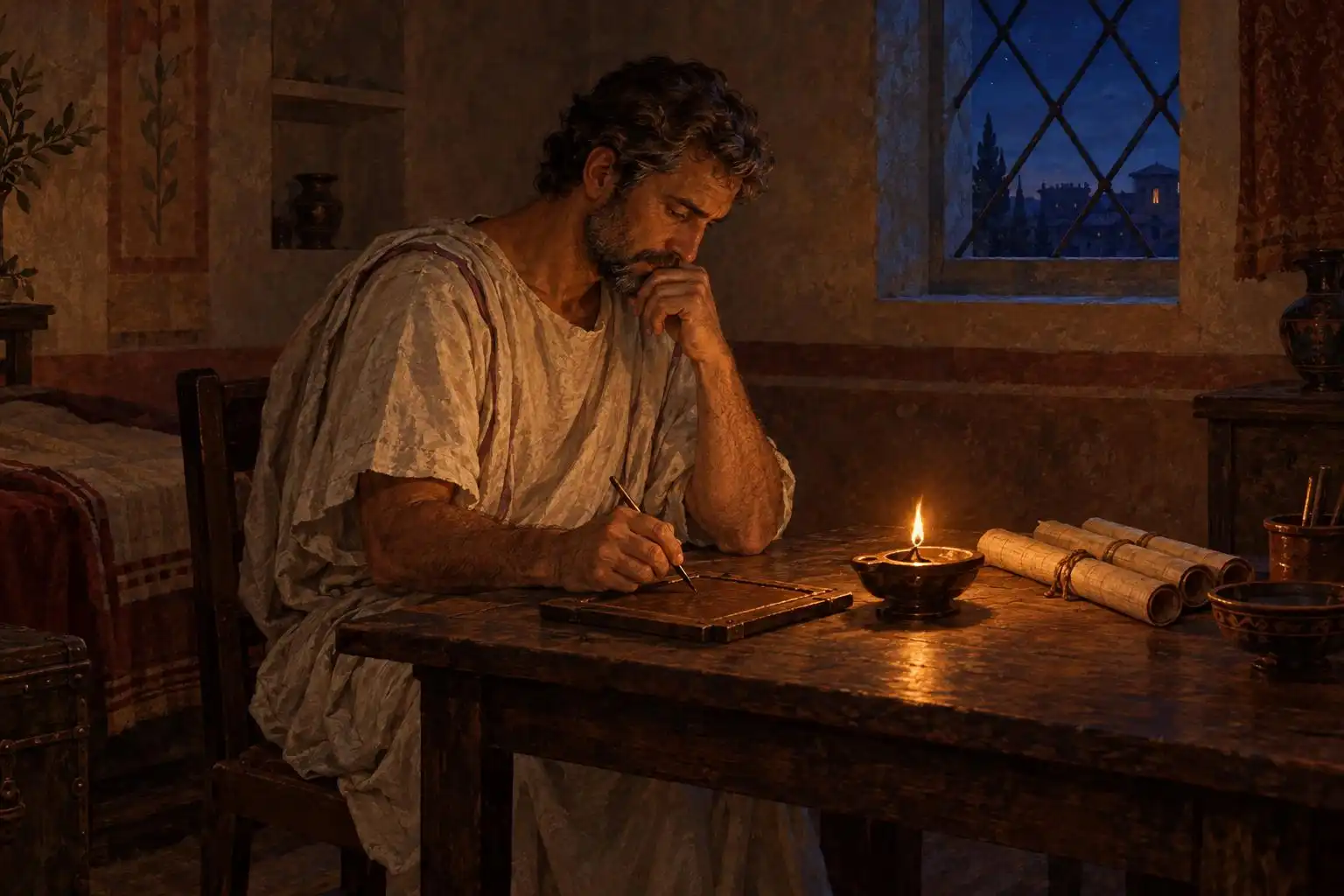
The moment before anger
Seneca does not think every jolt of feeling is a moral failure. In book two of On Anger, he distinguishes an involuntary first movement—the shock of an insult or the sight of an injury—from anger proper. A startled face, a racing pulse, the impulse to recoil: these arrive before deliberation has caught up. They are not yet the settled desire to retaliate.
Anger takes shape when a person accepts a judgment: I have been wronged, and someone must pay for it. Seneca’s point is not that we can decide never to feel the first sting. It is that the sting does not have to decide what follows. The interval may be brief, but it matters. In it, we can ask whether we understood what happened, whether the offense was deliberate, and what response would actually be just.
This is not a technique for making an unpleasant feeling disappear. It is an account of responsibility. Seneca holds us answerable for the judgment we endorse and the action we take, not for every sensation that crosses the body.
Why righteous anger troubles him
The obvious challenge is injustice. Surely anger at cruelty is better than indifference to it. Seneca’s answer in book one is that the alternatives have been badly framed. We can recognize cruelty, protect its victims, and punish an offender without wanting revenge. Justice needs an assessment of the act and a proportionate response. Anger wants satisfaction, and satisfaction is an unreliable measure of either.
He is especially concerned with punishment. A judge or parent may need to correct someone; an official may need to restrain a dangerous person. Seneca does not infer that the person exercising authority should be furious. The angrier the punisher, the more likely a penalty becomes a display of power rather than a considered means of protection or correction.
His view can sound suspiciously neat if anger has been the thing that finally made an injustice visible. There are circumstances in which the demand to be calm is itself a tactic of the powerful. Seneca’s argument deserves to be tested against that possibility, not waved through as timeless wisdom. Still, he identifies a real danger: noticing a wrong and taking pleasure in the prospect of hurting its author are different acts. We do ourselves no favors by calling both of them justice.
A broken cup and a pond of eels
Seneca’s most vivid example concerns Vedius Pollio, a wealthy Roman who ordered a servant thrown to his lampreys after the servant broke a crystal cup. The emperor Augustus, present as a guest, intervened. In Seneca’s telling, Augustus had the servant spared and ordered Vedius’s crystal cups smashed (On Anger, 3.40). A cup could be replaced. A human being was about to be killed for breaking it.
The episode shows what anger can become when authority gives it immediate means. Vedius did not merely feel affronted; he could turn his affront into a death sentence. Seneca makes the imbalance impossible to miss. He also makes Augustus’s intervention an example of restraint that does not amount to passivity. The emperor stops the punishment and publicly exposes its absurdity.
There is a limit to Seneca’s vision here. He condemns a monstrous exercise of a slaveholder’s power, not Roman slavery itself. That limit matters, especially if we are tempted to make him a convenient spokesman for our own convictions. Yet it does not erase the force of his observation. Anger is most dangerous when the angry person does not have to ask permission before acting.
Delay is more than a breathing exercise
Seneca recommends delay because anger presses for a verdict before the evidence is in. In book three, he counsels examining apparent offenses and resisting the urge to answer them at once. Time may reveal a misunderstanding, an accident, or an injury smaller than it first appeared. Even when the wrong remains, delay makes room to choose a response for reasons other than the pleasure of striking back.
He also describes a nightly examination of his own conduct (On Anger, 3.36). What fault did I resist? Where did I improve? Where did I make matters worse? This is not a performance of serenity. It is an attempt to catch patterns that are hard to see while defending them: the insult repeatedly taken, the excuse repeatedly made, the person repeatedly treated as an obstacle.
None of these practices guarantees good judgment. A composed person can be cruel, and an angry person can identify a wrong accurately. Seneca’s claim is narrower and more demanding. If we are going to act against wrongdoing, we should be able to say what we are trying to repair, prevent, or protect. “I was furious” is an explanation of how an action began. It is not yet a reason why it was right.
The question anger would rather skip
On Anger is often reduced to advice for keeping one’s temper. But Seneca’s argument becomes sharpest where tempers meet unequal power: the household, the courtroom, the ruler’s table. He asks what happens when a person who feels injured can make another person suffer. The first impulse may be involuntary. What we authorize it to do is not.
The useful question, then, is not whether we care enough to be angry. We may care deeply, and we may feel anger before we have had a chance to think. The question is whether the action we choose will serve the person harmed or merely satisfy the person offended. Seneca offers no comfortable way to answer it. He does insist that we answer it before someone else pays the price.



Leave a Reply
You must be logged in to post a comment.