
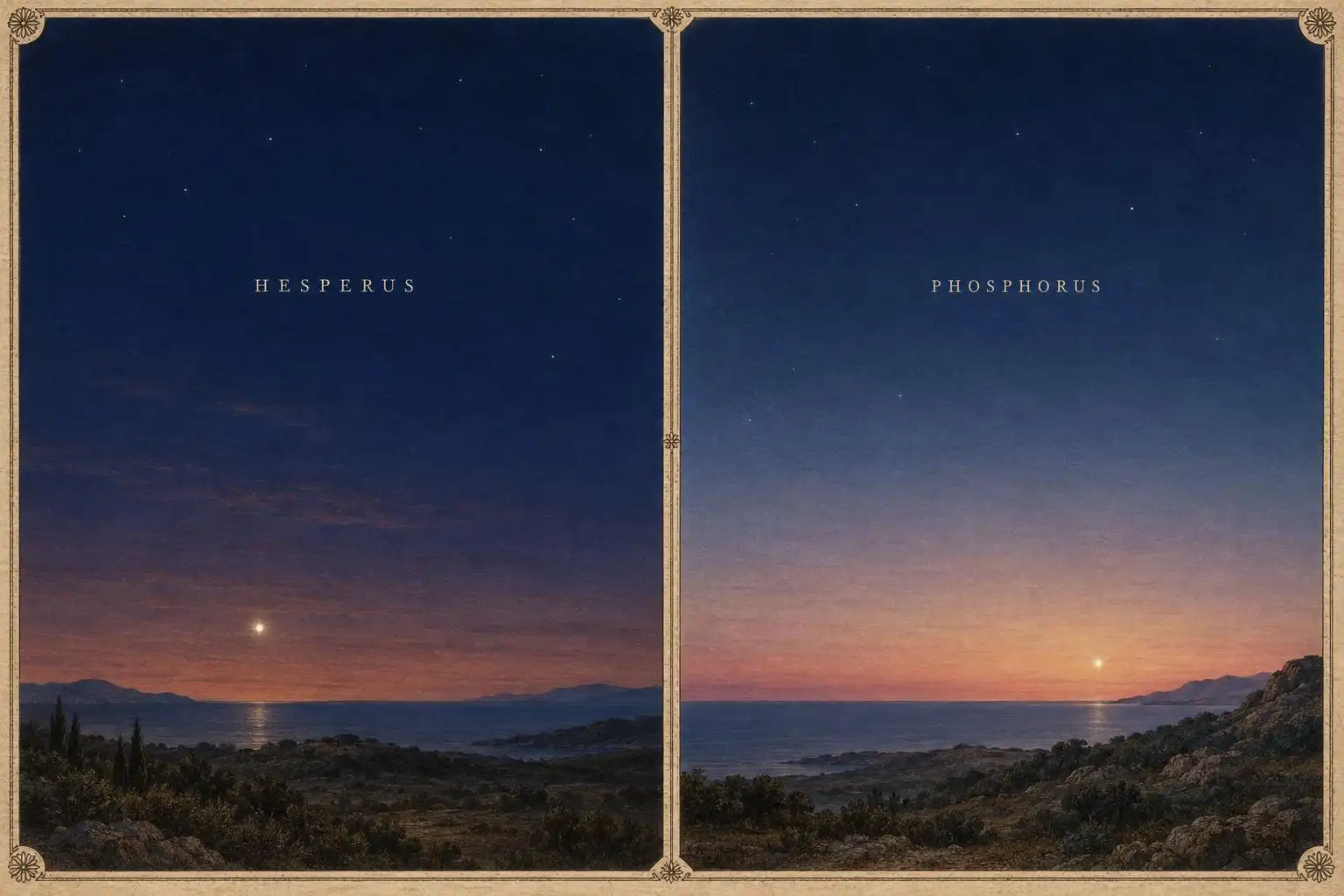

For centuries, observers gave two names to a bright point of light. Hesperus appeared in the evening; Phosphorus appeared before dawn. Astronomy supplied the surprise: both were Venus. It took observation to learn that Hesperus is Phosphorus. But once we know it, could the discovery have come out differently? Saul Kripke’s answer was yes in one sense and no in another. That distinction changed how philosophers thought about names, knowledge, and possibility.
A Discovery That Looks Contingent
The sentence “Hesperus is Phosphorus” can sound like an ordinary report of fact. Someone might reasonably have believed it false. Had the observations turned out differently, we would not have made the discovery at all. It is tempting, then, to call the sentence contingent: true, but capable of having been false.
Kripke asked us to be more exact about what might have differed. The evidence could have misled us. The object visible in the morning could have been a different planet from the object visible in the evening. But that would be a situation in which our names had been attached to different objects, not one in which Venus was distinct from itself. Once both names pick out Venus, “Hesperus is Phosphorus” says of that one planet that it is that one planet.
This was the turning point of the lectures Kripke delivered in 1970, later published as Naming and Necessity. A truth can require experience to discover it and still be necessary: it could not have been false of the very things it concerns. Kripke called this kind of truth necessary a posteriori.
Names Do Not Travel by Description
Why had the contrary view seemed so natural? One influential answer treated a name as closely tied to a description. On a simple version, “Aristotle” might mean “the teacher of Alexander the Great.” If so, when we imagine a world in which that teacher was someone else, it can seem that Aristotle was someone else too.
But Aristotle could have declined to teach Alexander. That possibility does not erase Aristotle from the story. We can still ask what he would have done instead. The description helps us identify a person in the actual world; it does not necessarily tell us whom the name picks out in every possible world.
Kripke called a name a rigid designator: it picks out the same object wherever we consider a possibility in which that object exists. “The teacher of Alexander,” by contrast, might pick out different people in different circumstances. The difference is not that names contain more information. It is that they need not operate by supplying a description at all.
Kripke sketched another way a name can reach its bearer. Someone first introduces it for a person or thing, perhaps by pointing. Others acquire it from speakers who already use it, intending to refer as they do. The name passes along a chain of communication. This is not a guarantee that names never drift or that reference is always easy to establish. It explains how we can successfully name someone while knowing remarkably little about them.
Necessity Is Not Certainty
The crucial distinction is between two questions. How do we know a statement is true? concerns evidence. Could it have been false? concerns possibility. Philosophers had often expected the answers to line up: necessary truths would be knowable by thought alone, while discoveries made through experience would describe how things happen to be. Kripke argued that the questions can come apart.
No amount of reflection in an armchair could have established that the two lights were Venus. Astronomical investigation was needed. Yet if “Hesperus” and “Phosphorus” both name Venus, there is no possible situation in which those very objects are different objects. There are possible situations in which people see different planets, make different observations, or use the names differently. None makes Venus two planets.
That last qualification matters. Kripke was not claiming that every sentence containing a name is necessary. “Venus appears in the evening” could have been false. Its orbit, the observer’s location, and the conditions of observation could have differed. What necessity protects in “Hesperus is Phosphorus” is the identity, not the route by which we found it.
What Water Adds
Kripke extended the argument from names to terms for natural kinds. Consider “Water is H₂O.” People recognized and used water long before they knew its chemical composition. Science, not an analysis of the word “water,” established the connection. Kripke nevertheless argued that, if being H₂O is what water is, the identity holds wherever water exists.
Imagine a liquid that looks and tastes like water, fills rivers, and falls as rain, but has a different molecular structure. It might have satisfied everything earlier speakers used to recognize water. On Kripke’s account, that would not make it water. It would be another substance that resembles water. As with the two names for Venus, familiar appearances can guide a discovery without fixing what the discovered thing could have been.
The water case also shows where the argument demands care. Whether a scientific claim expresses an identity, and how exactly to describe a natural kind, are substantive questions. Kripke’s point was not that chemistry becomes infallible when it uses the word “water.” It was that empirical investigation may reveal something about a thing that is not merely one of its changeable features.
The Question Left Open
Naming and Necessity did not make possible worlds into distant places where we could inspect alternate Venuses. They are a way of asking what might have happened to the very things we name. Once that question is put clearly, a small grammatical habit becomes visible: we often confuse changing the circumstances in which we identify an object with changing which object it is.
Kripke’s argument did not settle every question about how words acquire their reference. Communication can falter; scientific categories can be revised. But it forced a lasting separation between evidence and necessity. We learned that the evening light and the morning light were one planet by looking at the sky. What we learned, if Kripke was right, was not a fact that the planet itself might have made false.


Leave a Reply
You must be logged in to post a comment.