
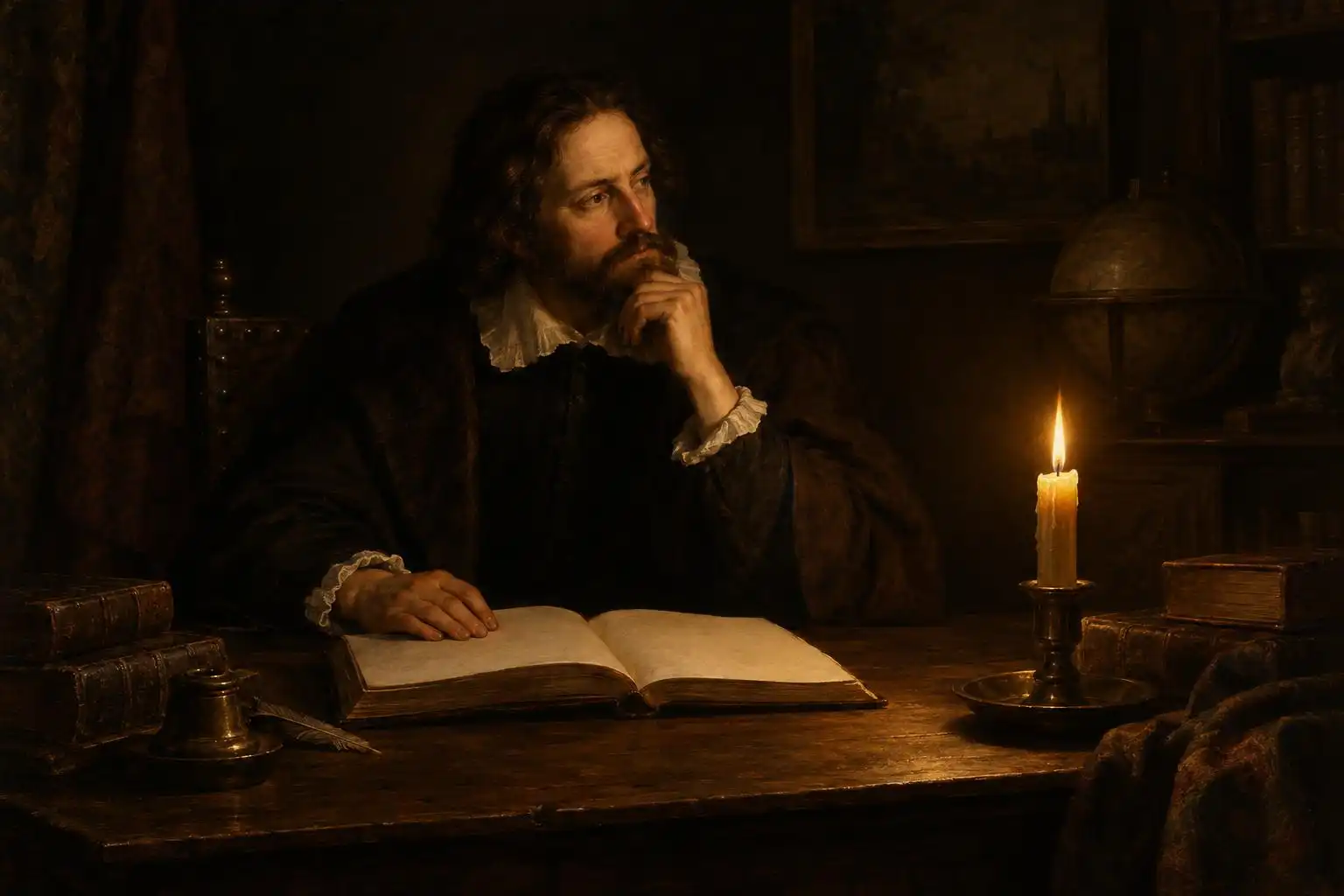

Suppose you discover that everything you see is a dream. The room, the book in your hands, even your own body might not be as they appear. Could you still be certain of anything? Descartes thought you could. The discovery at the centre of his Meditations is usually rendered as “I think, therefore I am.” It is a remarkably small claim—but its strength depends on keeping it small.
Why Descartes Begins by Doubting
In the First Meditation, Descartes sets aside beliefs that admit of doubt. His senses sometimes mislead him. Dreams can feel like waking life. He even imagines a powerful deceiver capable of making him mistaken about things that seem most obvious, including arithmetic. He is not claiming that such a deceiver exists; he is asking what would remain certain if deception went as far as he could imagine.

This is a method for finding a secure starting point, not a recommendation to stop trusting your eyes in ordinary life. Descartes wants a belief that survives the attempt to doubt it. In the Second Meditation, he finds one: while he is thinking, he cannot be wrong that he exists.
Why Deception Cannot Defeat the Cogito
The familiar wording, “I think, therefore I am,” comes from Descartes’ Discourse on the Method. In the Meditations, he puts the discovery more directly: “I am, I exist” must be true whenever he states it or conceives it in his mind.
Imagine the deceiver telling Descartes that he does not exist. If Descartes is being deceived, there must be someone undergoing that deception. If he doubts whether he exists, there must be someone doing the doubting. The attempt to make this particular belief false confirms it instead. Deception can change what he thinks is true; it cannot remove the fact that he is thinking.
“Thinking” here has a broad meaning. Descartes includes doubting, understanding, affirming, denying, willing, imagining and seeming to sense. If he appears to see a fire, there may be no fire. But that appearance is still occurring in his experience. He need not settle whether the world matches it to be certain that he is having it.
Is “Therefore” Doing Any Work?
The slogan can sound like an ordinary deduction: all thinkers exist; I am a thinker; therefore I exist. That reading raises an awkward question. Would Descartes first need to establish the general rule that thinkers exist, when his whole exercise is to doubt anything that might be called into question?
His point is better understood as an immediate recognition made in the act of thinking. He does not observe a thought and then search for its cause. In doubting his existence, he encounters something he cannot coherently deny at that moment: he is there to do the doubting. The word “therefore” marks the connection, but the certainty does not rest on an earlier proof of a general principle.
This also explains why the cogito is not merely a clever sentence that anyone can repeat. Reading “Descartes exists” gives you no special certainty about Descartes. The force of “I exist” comes from considering it in the first person, while you are thinking. It is an exercise a reader can perform, not a fact accepted on Descartes’ authority.
What Has Descartes Actually Established?
The result is narrower than it first appears. Descartes has not yet proved that he has a body, that other people exist or that his memories are accurate. Even the phrase “I exist” does not establish, by itself, how long he has existed. Its certainty holds whenever he is thinking it; it does not turn his entire life story into an indubitable fact.
Descartes next asks what this “I” is, calling it a thinking thing. That is a natural answer in his inquiry: thinking is the activity he cannot separate from his present certainty. But a further question remains. Does awareness of thinking prove that the thinker is an enduring, immaterial substance, distinct from the body? The cogito alone does not settle that. Descartes has more work to do before drawing his wider conclusions about mind, body and the external world.
A critic can press the point still harder: perhaps the experience warrants only “thinking is occurring,” not “I am thinking.” That objection challenges whether Descartes is entitled to move from an undeniable occurrence to a thinker understood as more than the subject of this present act. It does not make the occurrence doubtful. It asks exactly what must exist for it to occur.
A Starting Point, Not a Finished Philosophy
The cogito matters because of the peculiar way it withstands doubt. Most beliefs become less secure when we imagine being deceived. This one becomes more secure: even a mistake about whether I exist requires me to be there to make it.
That gives Descartes a starting point, not a complete picture of reality. Readers need not accept his later account of the mind to see the force of the discovery. Nor should they quietly add those later claims to it. At the moment of doubt, Descartes knows at least this much: he cannot think himself out of existence while he is thinking.


Leave a Reply
You must be logged in to post a comment.