
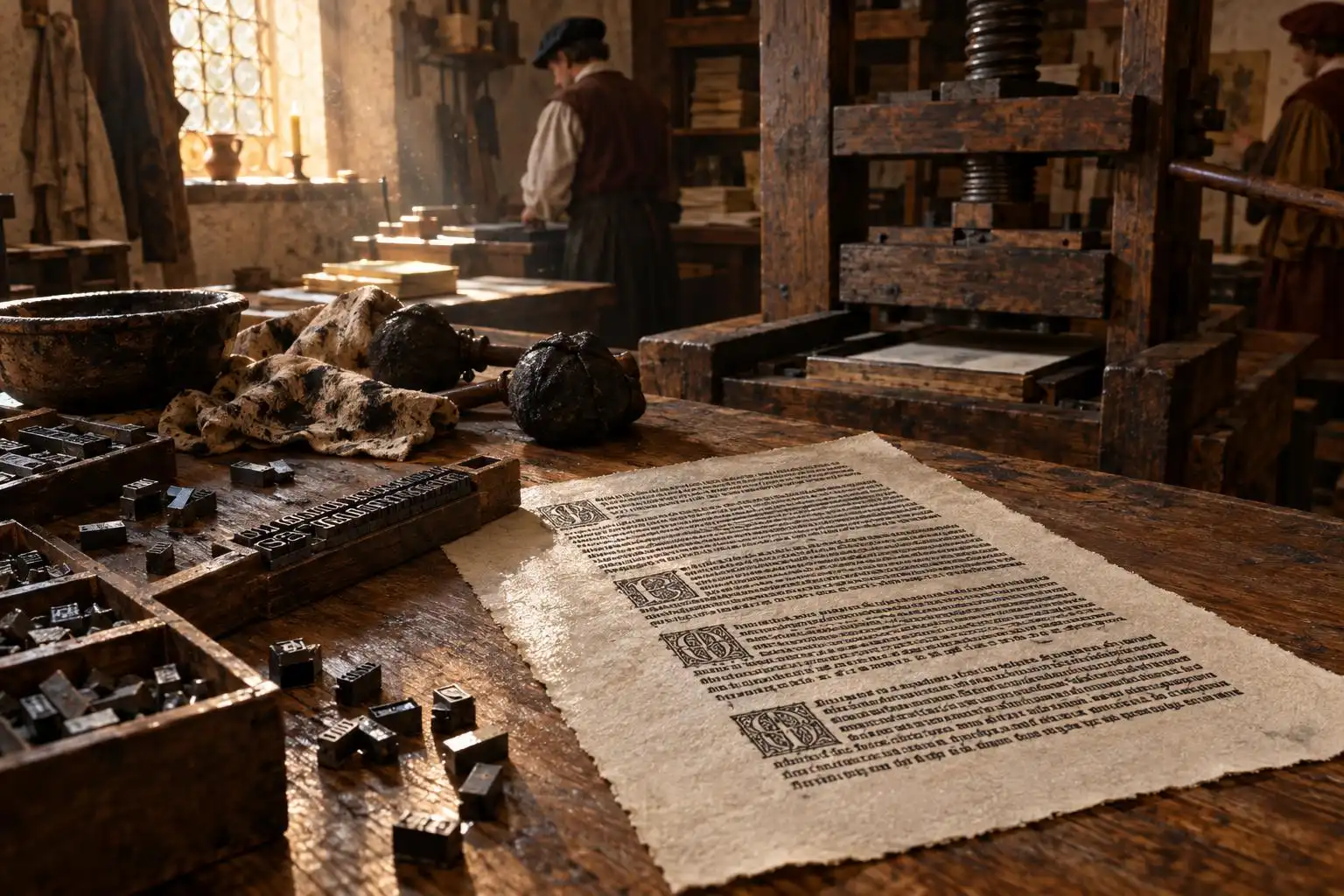

In December 1486, a slim printed booklet appeared in Rome. It contained 900 propositions that a young Italian nobleman, Giovanni Pico della Mirandola, offered to defend against anyone willing to dispute them. Pico even proposed to pay the travel expenses of scholars who came from afar. He was twenty-three, and he had imagined an audience worthy of his ambition.
He also wrote an opening speech for the occasion. Today it is often called the Oration on the Dignity of Man, a celebrated statement of Renaissance humanism. But the disputation never took place. Before Pico could deliver his speech, church authorities began examining the propositions. The oration’s fame rests, in part, on an event that did not happen.

Nine Hundred Claims and an Open Invitation
Pico’s proposed debate was no ordinary university exercise. His propositions ranged across philosophy, theology, mathematics, and the interpretation of sacred texts. Some came from authorities he admired; others challenged or recombined their arguments. He wanted to show that traditions apparently at odds could be brought into conversation—and, ultimately, made to disclose a deeper agreement.
That ambition depended on books and the people who could read them. Pico studied Greek, pursued Hebrew, and commissioned translations of Jewish writings. Flavius Mithridates, a convert from Judaism, translated texts that helped give Pico access to Kabbalah. The young philosopher’s apparent command of many traditions rested on this network of scholars, translators, and manuscripts. The printed propositions made that work public, and made its risks public too.
Pico’s invitation promised a dramatic sight: learned opponents testing claims face to face in Rome. Printing made it possible to circulate the claims before anyone arrived. It also put them where officials could inspect them without accepting Pico’s account of how they fit together.
What God Gives Adam
The speech Pico prepared begins with a question: why should the human being be called a marvel? His answer takes the form of a creation story. God has assigned places and natures to the rest of creation. When he turns to Adam, Pico imagines, no fixed place remains. Instead, God gives him the capacity to choose what he will become.
The passage can sound like an invitation to invent oneself without limits. Pico’s Adam, however, does not stand in an empty universe. He inhabits a ranked cosmos, with animals below and angelic intelligences above. A human being may sink toward the life of appetite or rise through disciplined thought and contemplation. Freedom is remarkable because it permits ascent; it is also dangerous because it permits descent.
For Pico, dignity is therefore less a possession than a task. The speech urges its hearers to study moral philosophy, natural philosophy, and theology in an ordered progression. The mind must be trained before it can approach divine things. His Adam has no settled station, but Pico is hardly indifferent to the direction he takes.
A Concord Built from Uneasy Materials
Pico wanted more than an account of human freedom. He hoped to reconcile Plato and Aristotle, whose disagreements had shaped centuries of philosophical teaching. He also sought wisdom in ancient religious texts and in Kabbalah, a body of Jewish mystical interpretation that he read through translations and recast in support of Christian claims.
That undertaking could be daring and coercive at once. Pico treated Jewish learning as intellectually indispensable, yet he also argued that it confirmed Christian doctrine. The traditions he assembled did not meet on equal terms. Their apparent harmony depended on his decision about what they truly meant.
Among the propositions were defenses of natural magic: practices Pico distinguished from the summoning of demons and associated with hidden powers in nature. He saw such inquiry as part of the search for knowledge. To church examiners, some of his claims raised questions that an appeal to philosophical harmony could not settle.
The Debate Stopped Before It Began
Pope Innocent VIII appointed a commission to examine the propositions. It singled out thirteen as suspect. Pico answered his critics in an Apology, but the planned public disputation was blocked. The opening speech remained unspoken.
The cancellation exposes a limit in Pico’s design. He had imagined learned disagreement as something an eloquent defender could resolve in public. His judges asked a different question: whether particular propositions could be permitted at all. In a dispute over doctrine, an invitation to debate did not guarantee a hearing.
Pico continued to write. He died in 1494, aged thirty-one. His nephew Gianfrancesco published a collection of his works in 1496, including the speech prepared for the Roman gathering. Readers encountered it on the page, without the arguments and interruptions that Pico had expected to follow his opening words.
The Unoccupied Floor
The Oration on the Dignity of Man is often read as though it announces a new age with a single declaration of human freedom. Its original setting is stranger. It was a preface to 900 disputable claims, written by a scholar who believed that ancient philosophers, Christian theologians, and translated Jewish texts might be drawn into one vast argument.
Near its beginning, Pico’s God addresses Adam and leaves his place in the world undecided. Pico intended to say those words before an assembly of challengers. Instead, they survived as the opening of a speech no one heard, while the promised disputation—the place where his claims were to be answered—remained empty.


Leave a Reply
You must be logged in to post a comment.