

A person can obey every rule and still feel accused. No one has caught them, no one has been harmed, and yet the verdict seems to have arrived before the trial. In On the Genealogy of Morality, Nietzsche asks where this intimate tribunal came from. His answer is unsettling: conscience did not begin as a quiet knowledge of good and evil. What we call bad conscience emerged when human beings lost the freedom to discharge their aggression outwardly and made themselves its target.
Before Guilt, There Was Debt
Nietzsche’s second essay begins not with sin but with the difficult business of making promises. To promise is to bind a future self: the person who owes must remain recognizable, accountable, and capable of paying. Nietzsche argues that this required a long, violent education in memory. A society had to make certain obligations impossible to forget.

His account turns on a feature of the German word Schuld: it can mean both debt and guilt. Nietzsche uses that overlap to propose an origin for moral obligation in the relationship between creditor and debtor. When a debtor failed to pay, the creditor could claim compensation in another form: the satisfaction of exercising power over the debtor. Punishment, in this account, did not first express moral outrage. It settled accounts, often through cruelty.
This is not a comforting origin story. Nietzsche does not invite us to admire the creditor’s violence. He wants to strip away the assumption that punishment has always carried the meaning we give it now. An institution may endure while its purposes change. The same painful act can be treated as repayment, warning, spectacle, or moral correction, depending on who has the power to interpret it.
The Animal Behind the Walls
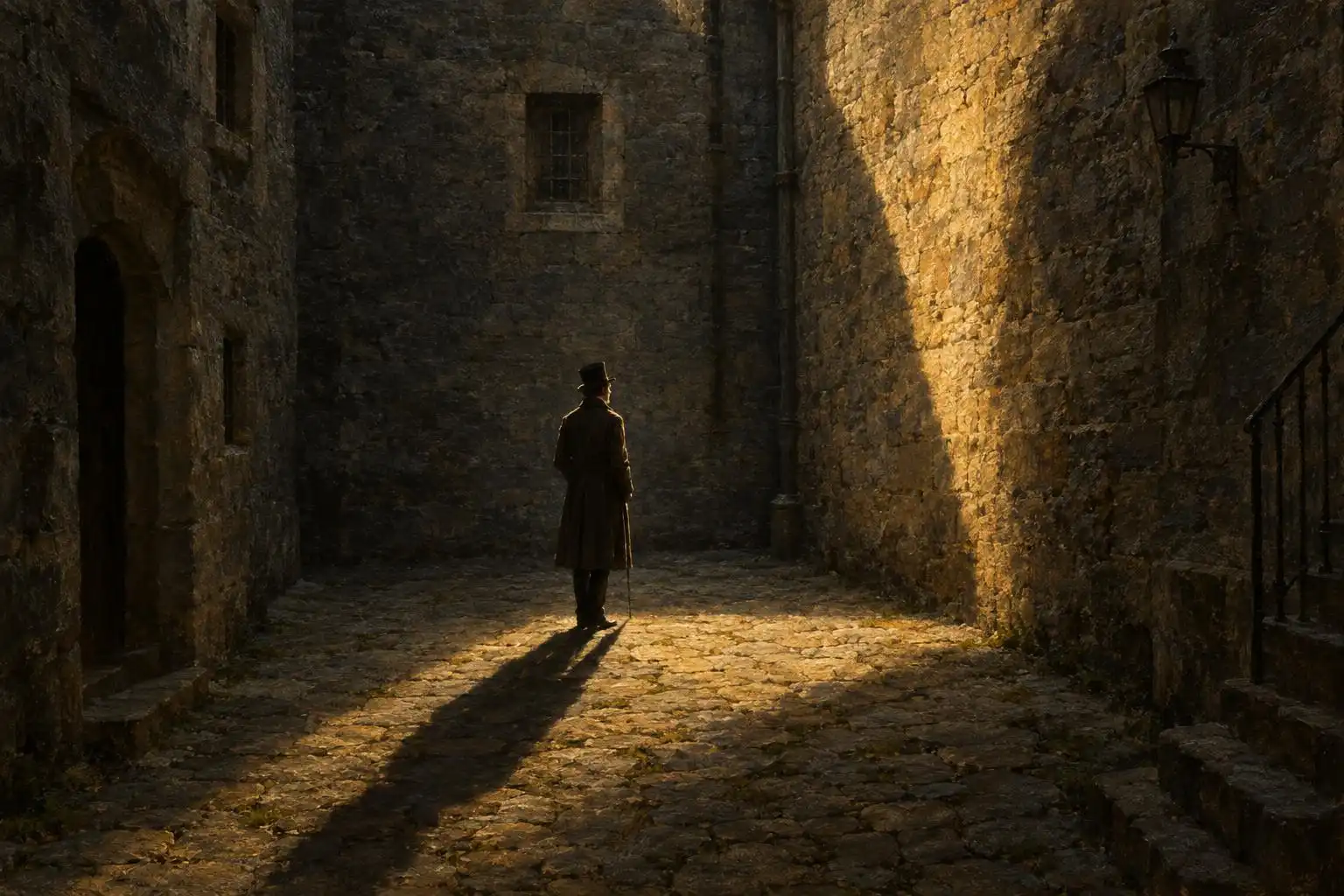
The decisive change comes when people are forced into settled social life. Nietzsche imagines human beings shaped by conflict, movement, and immediate action suddenly confined by rules they did not invent. Impulses that once found an outward path—hostility, the appetite for danger, the pleasure of domination—could no longer be expressed so freely. They did not disappear.
Nietzsche gives the transformation a brutal formulation: “All instincts that do not discharge themselves outwardly turn inward.” Human beings became, in his account, an animal compelled to work upon itself. The capacity to wound found a new object close at hand. Bad conscience was born from this inward turn: not the discovery of a moral law, but the suffering of drives denied their former outlets.
This is why Nietzsche refuses to tell the story of society as a voluntary bargain among reasonable equals. In the second essay, political order begins with conquest and coercion. The walls around the individual were built by force. Whatever we make of that speculative account, its role in his argument is clear: the inwardness we prize was not simply cultivated by reflection. It was also imposed.
Nietzsche’s picture of the human interior is consequently double-edged. A creature made to contain its own violence develops depth, imagination, and the capacity to shape itself. It also develops a talent for self-torment. The soul becomes spacious because something fierce has been locked inside it.
Punishment Is Not the Same as Remorse
If cruelty and punishment are everywhere in this history, it is tempting to assume that punishment taught people to feel guilty. Nietzsche explicitly resists that conclusion. Watching punishment, he argues, more often makes people cautious or calculating than remorseful. A person may learn that a deed was dangerous without coming to believe that the desire behind it was evil.
The distinction matters. Pain can enforce obedience, but it cannot by itself explain a conscience that condemns its own impulses. Nietzsche is searching for the moment when suffering acquires an interpretation: when a person understands inner conflict not merely as frustration but as evidence of fault.
Bad conscience therefore has a history beyond its first appearance. The inward-turned instinct supplies the force; later moral and religious interpretations tell the sufferer what that force means. Nietzsche’s genealogy is not a single neat chain in which one cause produces one result. It follows something more unruly: practices surviving their original uses, feelings taking on new names, and old forms of cruelty finding fresh justifications.
When the Debt Becomes Infinite
Nietzsche next follows the language of debt into relations with ancestors and gods. A community may feel that it owes its existence to those who founded and protected it. As the community grows more powerful, its sense of ancestral greatness grows too. What began as obligation to the dead can become obligation to a god.
Under Christianity, Nietzsche argues, the scale of this debt reaches a terrifying extreme. The creditor is now God, and the debtor’s obligation cannot be repaid by any ordinary act. More radically, the person comes to condemn their own nature. The inward-directed cruelty of bad conscience is given a religious interpretation: suffering becomes deserved, and the self becomes the thing from which one seeks release.
Nietzsche presents the Christian story of redemption as a startling reversal: God pays what humanity owes to God. He does not treat this as a simple cancellation of guilt. His question is what happens to a person’s imagination when an immeasurable debt has already been conceived. Even the promise of forgiveness takes shape against the thought of an obligation no human being could satisfy.
It would flatten the essay to say that Nietzsche merely blames Christianity for bad conscience. In his account, the inward turn begins earlier, with the enforced conditions of communal life. Christianity inherits that suffering and gives it an extraordinarily powerful meaning. Its power lies not in inventing the wound but in teaching the wounded person how to read it.
The Problem of the Inner World
Nietzsche does not offer a route back to an innocent life outside society. Nor does he simply ask us to discard the inner world produced by constraint. Bad conscience has helped make human beings capable of extraordinary self-scrutiny and creation. The trouble is that the same powers can be used to prosecute the self without end.
Near the heart of the second essay stands that image of instincts turning inward. It describes a force changing direction, not vanishing. Nietzsche leaves us with a harder question than whether conscience is good or bad: once an animal has learned to make itself its own territory, who decides what will be built there?


Leave a Reply
You must be logged in to post a comment.