
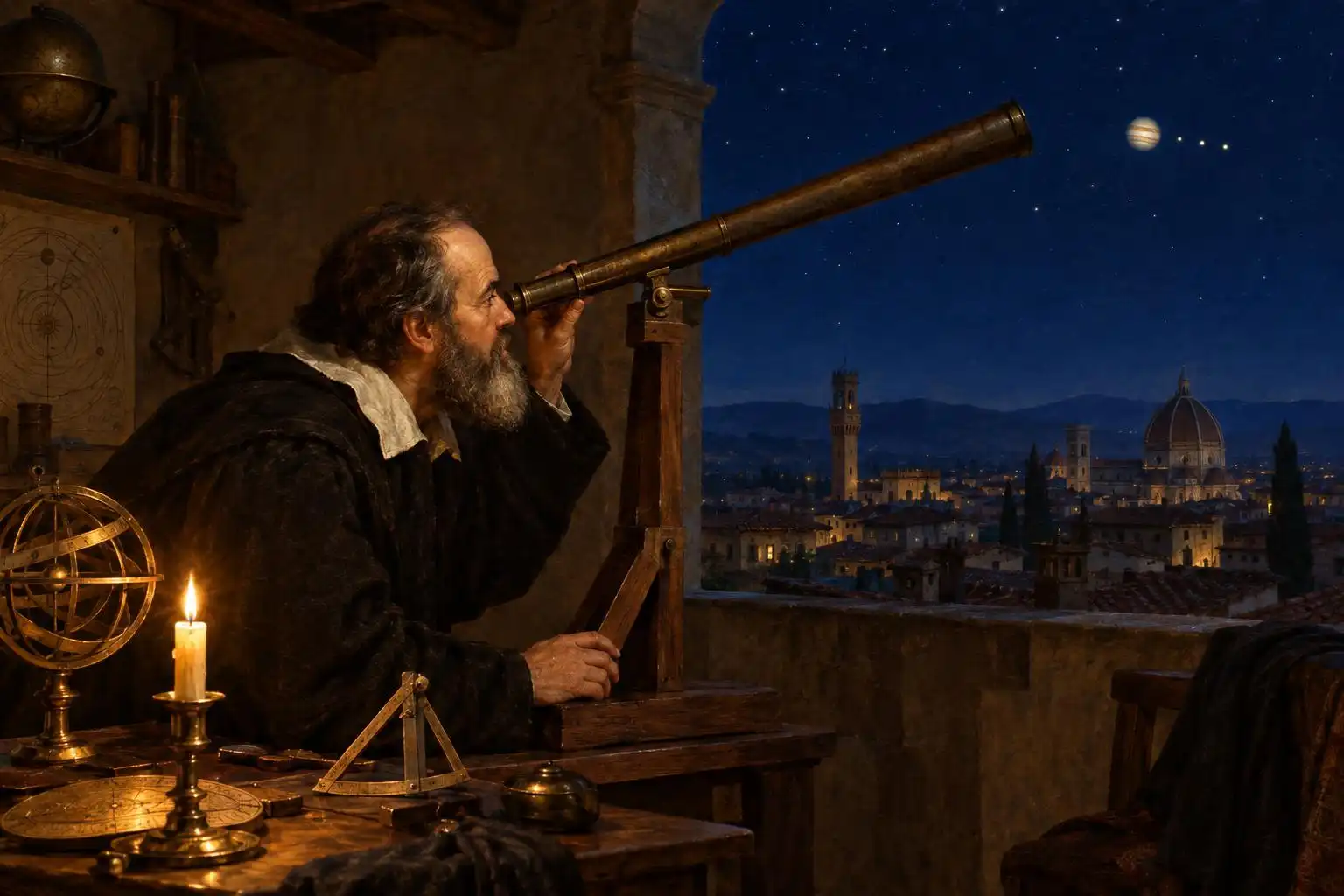

On the night of January 7, 1610, Galileo Galilei aimed his telescope at Jupiter and noticed three small points of light nearby. At first they looked like stars. Over the following nights, their positions changed in a way that ordinary stars could not explain. By mid-January, Galileo had identified four bodies circling the planet.
He had found something astonishing in the sky. He had also found something to give away. Before the discovery appeared in print, Galileo chose a name for the four bodies: the Medicean Stars, in honor of the ruling family of Tuscany.
A Telescope and a Record of Changing Positions
Galileo did not invent the telescope. Reports of the instrument reached Italy from the Netherlands in 1609, and he made his own increasingly powerful versions. At the University of Padua, where he taught mathematics, the device offered both an opportunity and a problem: what could its unfamiliar images be trusted to show?
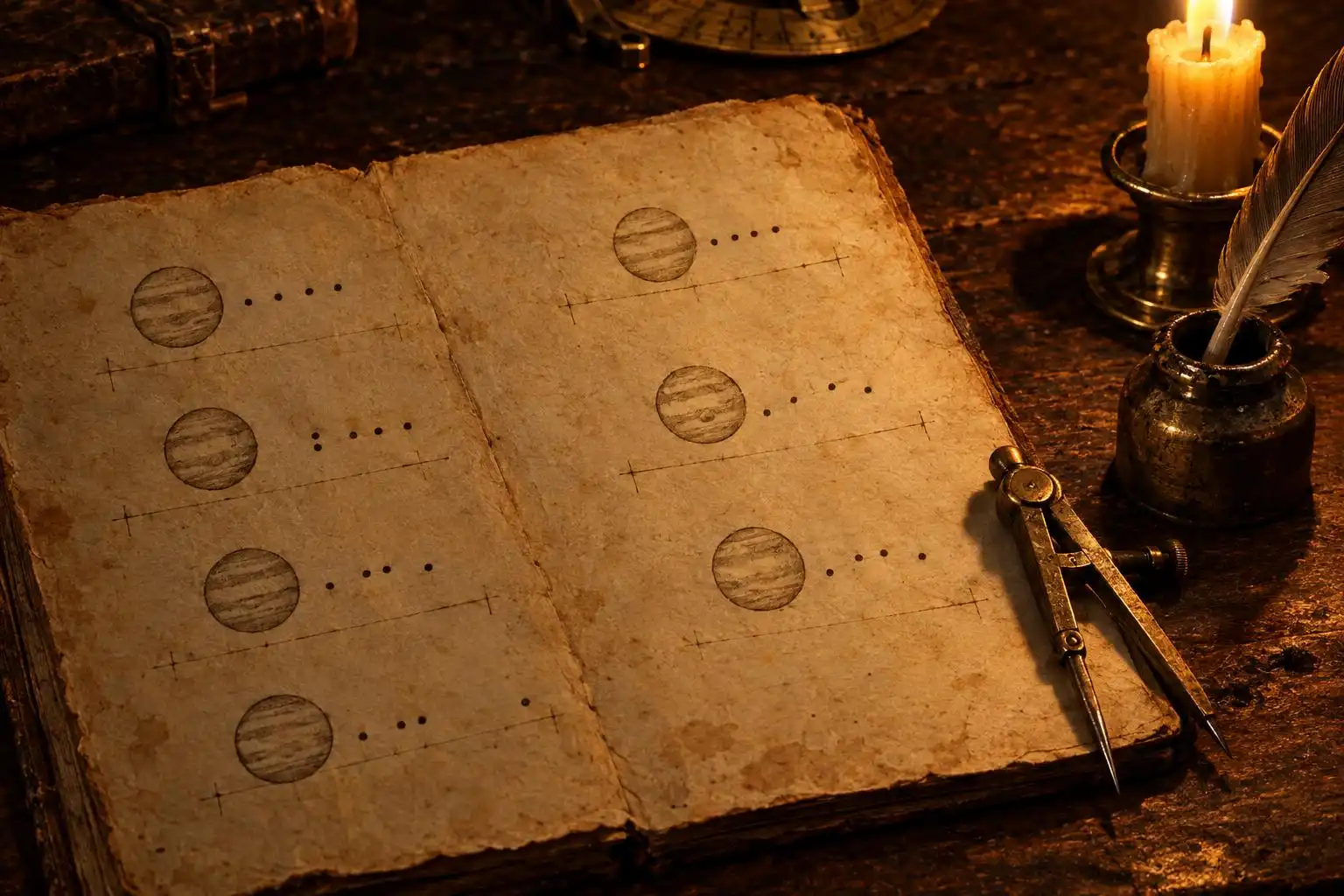
His notebooks supplied one answer. Galileo returned to Jupiter night after night, marking the positions of the tiny lights beside it. Sometimes there were three; sometimes four. Sometimes a light seemed to disappear, then appeared again on the other side. Rather than dismissing the irregularity, he followed it until the points formed a pattern: four bodies traveling around Jupiter.
The observation challenged a familiar assumption about the heavens. Earth had a moon, but here was another center of motion. In Sidereus Nuncius, published in Venice in March 1610, Galileo announced the discovery alongside his observations of the Moon’s uneven surface and the countless stars revealed by his telescope. The little book was both a report of what he had seen and a bid to be believed.
Why Name the Moons for the Medici?
Galileo’s position at Padua was secure enough to give him a livelihood, but teaching took time he wanted for research. He had long sought a place at the Tuscan court. As a young man, Cosimo II de’ Medici had studied mathematics with him; now Cosimo was grand duke. A dedication could turn that earlier connection into a renewed claim on his attention.
The four newly discovered bodies offered an unusually apt gift. Cosimo was one of four sons of Ferdinando I de’ Medici, and Galileo presented the moons as celestial emblems of the family. Calling them the Medicean Stars did more than flatter a patron. It placed the Medici name beside a discovery that Galileo expected other astronomers to discuss and observe.
This was how learned work often moved through early modern courts. A patron might reward a book, an instrument, or a discovery with money and a position. The exchange was not separate from intellectual life: it could determine who had the leisure to investigate, who could afford to publish, and whose claims reached influential readers. Galileo’s name for Jupiter’s moons belonged to that world of gifts and obligations.
Making a Discovery Public
A printed announcement could travel beyond the circle that had seen Galileo’s telescope. It could also establish when he had made his claim. Sidereus Nuncius included dated observations and diagrams of Jupiter’s changing companions, giving readers a record to examine rather than asking them to accept a single remarkable night’s report.
The book could not settle every objection. Telescopes were difficult to make well, and not everyone who looked through one saw the same thing at once. Galileo needed other observers to find the moons for themselves. In 1611, astronomers at the Jesuit Collegio Romano confirmed key telescopic observations, lending weight to reports that had initially seemed hard to credit.
The name was less secure than the finding. Galileo’s “Medicean Stars” did not remain their ordinary designation. Simon Marius, who also reported observations of Jupiter’s moons, published the names Io, Europa, Ganymede, and Callisto in 1614; those are the names that endured. A patron could lend a discovery prestige, but he could not control how later observers would speak of it.
What Jupiter Did—and Did Not—Prove
Galileo saw in Jupiter’s moons a powerful reply to the objection that Earth could not move around the Sun while the Moon accompanied it. If bodies could circle Jupiter as Jupiter traveled through the heavens, a moon attending a moving Earth no longer looked impossible.
The discovery did not, by itself, prove that Earth orbited the Sun. Astronomers could accept Jupiter’s moons while holding to a system in which Earth remained stationary. The telescopic evidence mattered nonetheless: it made the heavens harder to describe as a set of motions all centered on Earth, and it gave Galileo a new observation from which to argue.
That distinction can be easy to lose when the discovery is told as a single triumph. In 1610, Galileo had recorded a pattern in the sky, interpreted it, and published an argument for others to test. What followed depended on readers, rival observers, better instruments, and institutions willing to hear him.
A Place at Court
Later that year, Galileo left Padua for Florence. He became mathematician and philosopher to the grand duke of Tuscany, as well as chief mathematician at the University of Pisa, without the ordinary burden of lecturing. The appointment gave him more room to pursue his investigations. It also drew him closer to the expectations of a court whose favor he had deliberately sought.
The pages of Sidereus Nuncius preserve both sides of the exchange. Its dedication raises the Medici toward the heavens; its diagrams bring Jupiter back down to a sequence of small marks beside a circle. On one night a point is to the east, on another to the west. Whatever name appeared on the title page, those shifting marks were what another observer had to find.



Leave a Reply
You must be logged in to post a comment.